Dubstep: Solar System
A neon rhythm runner through a winding tunnel from Mercury to Pluto: tap the beat-gates on the beat, chain PERFECTs and ignite Star Power.
Links go to the official store or developer page. Last verified Nov 3, 2026.
Where to play
Every platform this game is on. Links are checked against official sources; we never host or mirror games.
- View on SteamSteamReleased$3.99
Download through the Steam app. A free Steam account is required.
Desktop · Steam
About Dubstep: Solar System
Dubstep: Solar System is an endless rhythm runner set to dubstep. Your ship stays fixed on screen while a winding tunnel scrolls toward you; you climb and dive to keep off its floor and ceiling and tap beat-gates in time with the music, travelling outward through nine worlds from Mercury to Pluto, each with its own colour, gravity and track. Hitting a gate's sweet spot on the beat scores a PERFECT; chains of perfects pay escalating Vibe Coins, push you forward and, after three in a row, repair the hull, and long chains trigger Star Power, a spell of invincibility at double speed that smashes through spikes. Each lap of the solar system is harder, and clearing Round 5 wins the game. Vibe Coins buy eight ship skins in the Hangar, and there are 26 trophies, three difficulty levels (Chill, Normal and Brutal) and an end-of-run statistics page. The developer's Steam AI disclosure says much of the code was written with AI coding assistants under the developer's direction, while design, difficulty tuning and play-testing are human work; the 46-track soundtrack was generated with Suno, and nothing is generated by AI while you play. Built with Godot 4 and published under the label Vibe Coded Reality, it is a paid game on Steam for Windows, released 28 Aug 2026; since version 0.15 an in-game shop sells the soundtrack's tracks. The store page carries a photosensitivity warning for flashing lights.
Screenshots and art
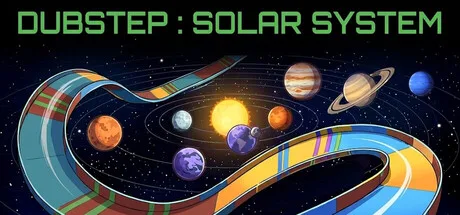
Dubstep: Solar System key art · Steam store artwork
How it was built
Partially verifiedThe developer's Steam AI disclosure says much of the game's code was written with AI coding assistants working under the developer's direction, and that all game design, difficulty tuning and play-testing are human work. The 46-track soundtrack was generated with Suno from the developer's prompts under a paid commercial licence, each track hand-picked and play-tested against the beat-gate timing, and the cover and capsule art were made with AI image tools and then composed and typeset by the developer. In-game visuals are drawn procedurally by the game's code, and nothing is generated by AI at runtime. No coding assistant or model is named.
Per the Steam disclosure, AI coding assistants wrote much of the code under the developer's direction, while design, difficulty tuning and play-testing were done by hand; the music came from Suno and the store art from AI image tools, and the in-game visuals are drawn procedurally by the code. The store page says the game was made with Godot 4.
- Engine / framework
- Godot 4
- Languages
- Not disclosed
- Team size
- Not disclosed
- Development time
- Not disclosed
- Development cost
- Not disclosed
- AI-written code
- Not disclosed
“Much of the game's code was written with AI coding assistants working under the developer's direction; all game design, difficulty tuning, and play-testing are human work.”Verification notes: The AI claim rests on the developer-written AI disclosure on the game's Steam page (re-read on 4 Nov 2026): much of the code was written with AI coding assistants. No tool is named, so the tool is recorded as undisclosed, and “much of” is not most, so the game is classed as AI-assisted. The store page calls the soundtrack “licensed”; the disclosure says it was generated with Suno under a paid commercial licence. Engine (Godot 4), the planned trilogy and the photosensitivity warning from the store description; the Track Shop from the developer's version 0.15 post (18 Sep 2026). Release date, price, Windows only and English (with full audio) from the Steam store API; the store page showed no user reviews on 4 Nov 2026, so no review figures are recorded. No website is listed.
Development history
Released on Steam for Windows at US$3.99.
OfficialSteamVersion 0.15 adds the Track Shop, where the soundtrack's tracks can be bought through Steam and exported as MP3s.
Game performance
Each figure measures something different — concurrent players, owners, downloads and sales are never interchangeable and are never added together. Labels show where each number comes from.
Steam
US$3.99 on the Steam store API (US region, no discount) on 4 Nov 2026. Windows only. Since version 0.15 (18 Sep 2026) an in-game Track Shop sells the soundtrack's tracks through Steam (US$0.99 each, or packs up to US$24.99 for every track) and lets you export owned tracks as MP3s; ship skins are bought with Vibe Coins earned in play.
Not publicly available: Concurrent players, Steam reviews, Positive Steam reviews, Estimated owners, Gross revenue.
Sales & revenue (all platforms)
Reviews & rankings
Not yet reviewed by our editors.
Not currently ranked.
Sources
| Source | Type | Published | Accessed |
|---|---|---|---|
| Dubstep: Solar System on Steam (store page incl. AI Generated Content Disclosure) Steam | Store page | Not confirmed | Nov 3, 2026 |
| Dubstep: Solar System v0.15 adds the Track Shop, a new button on the main menu. Steam (Dubstep: Solar System news) | Devlog | Sep 18, 2026 | Nov 3, 2026 |
- Real-money purchases
- The store description says every Vibe Coin is earned by playing and “there is nothing to buy with real money”; since version 0.15 (18 Sep 2026) the in-game Track Shop sells the soundtrack's tracks for real money through Steam, and Steam lists the game with In-App Purchases. (Steam, Steam (Dubstep: Solar System news))