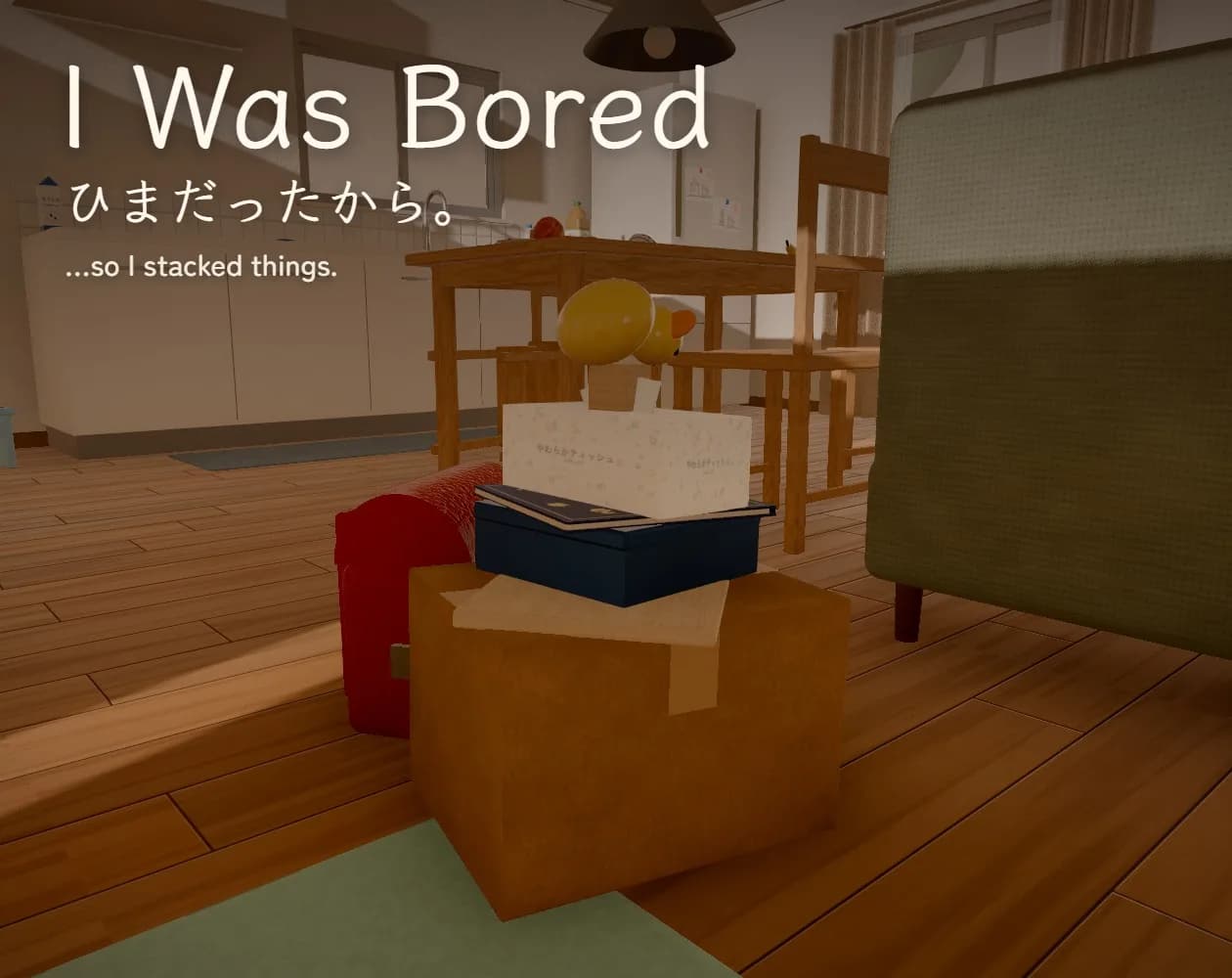
ひまだったから。
Stack everyday household things as high as you can from a five-year-old's eye level; its developer says Claude Code built it almost on its own in two days.
Official site makeyourown.itch.io, verified Nov 3, 2026. Linked as “itch.io で遊ぶ” from the developer's site makeyourownlab.com and from the developer's note posts.
Where to play
Every platform this game is on. Links are checked against official sources; we never host or mirror games.
- Play free — itch.ioitch.ioReleasedFree
Plays in the browser on itch.io. No download.
Browser (no download) · Mobile · Official link verified Nov 3, 2026.
- Play free — Freem!Freem!ReleasedFree
Plays in the browser on Freem!. No download.
Browser (no download) · Official link verified Nov 3, 2026.
About ひまだったから。
A free first-person 3D stacking game in the browser. You are five years old, home alone until Mom gets back from shopping, and bored, so you pick up the ordinary things lying around the house, picture books, toy blocks, a toy car, bottles, mugs, a school backpack, a daruma, floor cushions, a cardboard box, and stack them as high as you can. Weight, shape and slipperiness are modelled, so the order and angle you stack in decide how high the tower gets; what you hold trembles a little, more with heavy things, and a careful mode steadies it. Once the tower is taller than you, you climb onto a step stool or a chair. The house has a living room and a tatami room, with afternoon light slowly turning to sunset. There are two modes, a 10-minute run that ends with a photo of your tallest tower and free play, plus 14 challenges. It works with mouse and keyboard and, since version 1.2, with touch on phones and tablets, in Japanese or English. The developer, who usually writes code by hand, says Claude Code with Claude Opus 5.5 built the game almost on its own from one short request and a few “please continue” messages, and that all graphics and sounds are generated by code.
How it was built
VerifiedThe developer says the game was made with Anthropic's Claude Opus 5.5 in Claude Code. The first request was a few lines (a first-person 3D game from a child's eye level about stacking ordinary things in a house, with realistic graphics and fairly realistic physics, cozy but fairly hard, any tech stack), set as a goal for Claude Code to work towards on its own; apart from that, the game itself was made with only “please continue” messages. Claude chose Three.js, the Rapier physics engine and Vite because it could run and check the result itself, and built its own checks: 840 automated physics placement tests, a script that plays the game and reports the tower height, and screenshots it reviewed. All textures, models and sounds are generated in code. Claude also helped with the English text and with filling in the publishing forms; the developer made the final checks and decisions to publish. The game pages say the program and in-game text were made together with Claude.
- Developeritch.io page: the program and the in-game text were made together with AI (Anthropic's Claude); all graphics, 3D models and sounds are generated by code, with no AI image or audio generators. — itch.io
- DeveloperFreem! page: the same statement in Japanese. — ふりーむ! (Freem!)
One prompt, then autonomy: the developer gave Claude Code a short brief and a goal, and Claude Code built the game, choosing a Three.js + Rapier + Vite web stack because it could test it without a person. The developer credits the self-checking setup most: headless physics tests, an automated player that measures tower height, and screenshots the AI inspects for colour, brightness and broken text. Physics fixes included swapping wobbling flat-bottomed shapes for cylinder and sphere colliders and using sphere colliders for the toy car's wheels. Performance work took a frame on an integrated GPU from 115 ms to about 16 ms at medium quality, and the Japanese font was cut to the 384 characters the game uses (29 MB to 370 KB). The first request went in on 25 Sep 2026 and the game was public on 26 Sep. The developer says the account set-up, payments, irreversible actions, social posts, and judging sound and mouse feel stayed with the human.
- Engine / framework
- Three.js with the Rapier physics engine (built with Vite)
- Languages
- Not disclosed
- Team size
- 1 (solo)Developer ReportedMake Your Own Lab
- Initial build time
- 2 days from the first request to public releaseDeveloper Reportednote (MakeYourOwn)
- Development time
- Not disclosed
- Development cost
- Not disclosed
- AI-written code
- Not disclosed
“The program and the in-game text were made together with AI (Anthropic's Claude). All graphics, 3D models and sounds are generated by code — no AI image or audio generators were used.”Verification notes: AI use from the developer's making-of post on note (27 Sep 2026), which names Claude Opus 5.5 in Claude Code, and the AI notes on the itch.io and Freem! pages and the developer's site, which say the program and in-game text were made with Claude. The developer's site links the itch.io and PLiCy versions and both note posts; the launch post also links the Freem! page. The game is also on PLiCy (plicy.net/GamePlay/238051), a Japanese game-sharing site we do not track. Release: the making-of post says the game went public on itch.io and PLiCy on 26 Sep 2026; the itch.io launch devlog is timestamped 27 Sep 07:56 UTC. The developer's site says the developer works alone. The code language is not stated, so none is recorded. itch.io shows no public rating. The developer's own description says nothing is generated by AI during play.
Development history
The developer gives Claude Code the first request for the game.
Developernote (MakeYourOwn)Released free on itch.io and PLiCy; the developer announces it on note the same evening.
Version 1.1: tipped-over chairs count as part of the tower, and the child gets a small chair of their own.
Developeritch.ioPublished on Freem! as a browser game.
Officialふりーむ! (Freem!)Version 1.2 adds touch controls for phones and tablets, in portrait or landscape (itch.io devlog; the Freem! file was updated to 1.2 on 15 Oct).
Game performance
Each figure measures something different — concurrent players, owners, downloads and sales are never interchangeable and are never added together. Labels show where each number comes from.
itch.io
Free to play in the browser (WebGL2), with optional donations. Phones and tablets are supported from version 1.2.
No public metrics recorded for this listing.
Not publicly available: itch.io rating, Gross revenue.
Freem!
Free browser version on Freem! (“Play on Browser”).
No public metrics recorded for this listing.
Sales & revenue (all platforms)
Browser game — there are no downloads to count.
Reviews & rankings
Not yet reviewed by our editors.
Prototype: your vote is kept only in this browser and is not counted anywhere.
Not currently ranked.
No player reviews yet.
Prototype: reviews are stored in your browser only and are not published or sent to a server. Reviews are shown in the language they were written in.
Sources
| Source | Type | Published | Accessed |
|---|---|---|---|
| I Was Bored — ひまだったから。 by MakeYourOwn itch.io | Store page | Not confirmed | Nov 3, 2026 |
| ひまだったから。 (ふりーむ!) ふりーむ! (Freem!) · Japanese | Store page | Oct 8, 2026 | Nov 3, 2026 |
| Claude Opus 5.5と2日で3Dゲームを作って公開するまで ―AIに“自分で確かめられる環境”を渡す note (MakeYourOwn) · Japanese | Devlog | Sep 27, 2026 | Nov 3, 2026 |
| 小さい頃,ひまな時間に何をしていましたか? ―ひまだったから,ゲームを作った話 note (MakeYourOwn) · Japanese | Devlog | Sep 26, 2026 | Nov 3, 2026 |
| ひまだったから。 — Make Your Own Lab Make Your Own Lab · Japanese | Official site | Not confirmed | Nov 3, 2026 |
- Freem! release date
- Freem! shows the game as registered on 8 Oct 2026; the developer's making-of post says it went public on Freem! on 10 Oct. (ふりーむ! (Freem!), note (MakeYourOwn))