
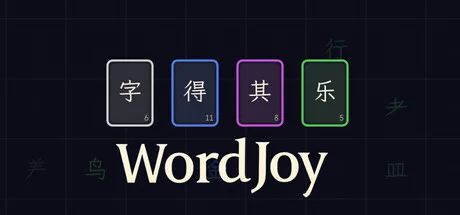
字得其乐 WordJoy
A Chinese-character deckbuilder on Steam: assemble character components on a 3×3 board and chain Five Elements skills; the developer says it was purely vibe-coded with Codex CLI and GPT models.
Links go to the official store or developer page. Last verified Nov 4, 2026.
Where to play
Every platform this game is on. Links are checked against official sources; we never host or mirror games.
- View on SteamSteamReleased$2.99
Download through the Steam app. A free Steam account is required.
Desktop · Steam
- View demo on itch.ioitch.ioDemo · Free browser prototype titled ZiGrid (itch.io status: Prototype), with ten levels, mouse and touch controls, English and Simplified Chinese; loads a 20 MB Chinese fontFree
Plays in the browser on itch.io. No download.
Browser (no download) · Official link verified Nov 3, 2026.
About 字得其乐 WordJoy
A single-player strategy game that mixes Chinese-character puzzles with deckbuilding. Character components sit on a 3×3 board like building blocks; you move, swap and draw cards to bring components together into valid characters and score points, with a limited number of actions per level. The store page lists more than 300 components, 3,500 characters to form and more than 100 skills. As levels progress, components gain skills based on the Five Elements (metal, wood, water, fire and earth) that combine with each other, and a combination preview shows what a new component can form. The way characters are split into components follows the Wubi input method, which the developer learned as a child; clicking a character plays its pronunciation. The developer, chunq, says the first scoring design was modelled on Balatro, then changed so that a component's position on the board also counts. In the developer's account the game was built with GPT models and Codex CLI using plain web technology, and it is described as purely vibe-coded. Paid on Steam for Windows (US$2.99), released 18 Mar 2026; a free browser prototype titled ZiGrid is on itch.io.
Screenshots and art
字得其乐 WordJoy key art · Steam store artwork
How it was built
Partially verifiedIn a blog post about the game the developer writes that, with AI developing quickly, the developer built it in about half a month of spare time with the help of GPT-series models and Codex CLI; the core gameplay took about a week and the rest went into styling and details. The development environment was Windows 10 with WSL and Codex CLI: the developer first used Codex CLI in PowerShell, but Codex often wrote and ran its own Bash scripts there and hit escaping errors, so the developer moved to WSL. The game uses plain web technology with Web Components and DOM rendering, after an HTML5 Canvas version rendered Chinese text blurrily, and the Web Speech API for pronunciation. The post says the whole game was developed with AI assistance; the developer designed the rules. The post describes the game under the browser title ZiGrid and does not name WordJoy; no GPT model version is named and no code share is given.
- DeveloperIn a V2EX reply in April 2026 the developer links the Steam page and says this game, developed purely by vibe coding (纯 Vibe 开发), is out on Steam. — V2EX
- DeveloperThe Steam AI disclosure says AI tools were used during development for code assistance, translation and text drafting, that all rules, data and player-facing content are reviewed by the developer, and that no AI is generated live during play. — Steam
- DeveloperThe itch.io AI disclosure for the ZiGrid prototype ticks AI Assisted: Code and Text. — itch.io
- DeveloperIn a May 2026 post about the next game the developer writes that GPT had become unusable for features it used to write in a few sentences, and was looking for a replacement for GPT as the main tool for writing code. — 春秋一语 (chunqiuyiyu.com)
Built on Windows 10 with WSL and Codex CLI, driving GPT-series models, in plain web technology: Web Components and DOM rendering (an early Canvas version rendered Chinese text blurrily), and the browser's Web Speech API for pronunciation. The developer designed the rules; the scoring started from a Balatro-like formula (component strokes × number of components) and was changed so that board positions count, because most characters players can form have no more than four components. A later update (v6.5.1) enlarged the cards, added the combination preview, reworked the Five Elements skills and added English, Traditional Chinese and Japanese. In May 2026 the developer said the idle gameplay of the developer's browser game HanGrid had been added to WordJoy.
- Engine / framework
- None (plain web technology with Web Components)
- Languages
- JavaScript
- Team size
- Not disclosed
- Initial build time
- About half a month of spare time, with the core gameplay in about a weekDeveloper Reported春秋一语 (chunqiuyiyu.com)
- Development time
- Not disclosed
- Development cost
- Not disclosed
- AI-written code
- Not disclosed
“正好这几年 AI 快速发展,我断断续续利用半个月左右的零碎时间,借助 GPT 系列模型和 Codex CLI 把它做了出来。”Verification notes: The vibe-coding claim for the Steam game is the developer's V2EX reply of April 2026, which links the Steam page. The tool comes from the developer's blog post of 24 Sep 2026, which describes the same game (Wubi-style components on a 3×3 board, deckbuilding, Five Elements skills) under the browser title ZiGrid and links the itch.io prototype, but never names WordJoy; that the Steam build shares the prototype's code is implied, not stated. The Steam AI disclosure is more modest, describing AI as code assistance, translation and text drafting. The developer is tied across sites by name: Steam developer and publisher chunq, itch.io author chunq, the blog footer (© chunq, GitHub chunqiuyiyu) and the V2EX account chunqiuyiyu. The posts are in the first person and name no other contributors, but no source states the team size, so it is not recorded. Release date, price, Windows only, the four languages, the AI disclosure and the review count from the Steam store page on 4 Nov 2026. In May 2026 the developer said HanGrid's idle gameplay had been added to WordJoy; whether that code was written with Claude Code and DeepSeek, as HanGrid was, is not stated. The developer cites Balatro as the starting point for the scoring design only; no third-party assets are named. A copy of the prototype also runs on the developer's site (chunqiuyiyu.com/zigrid/).
Development history
Released on Steam for Windows.
OfficialSteamOn V2EX the developer says the game, developed purely by vibe coding, is out on Steam.
DeveloperV2EXThe developer says the idle gameplay of the developer's browser game HanGrid has been added to WordJoy.
DeveloperV2EX (chunqiuyiyu)Blog post on how the game was built with GPT models and Codex CLI, linking the ZiGrid browser prototype.
Developer春秋一语 (chunqiuyiyu.com)Major update (v6.5.1): larger cards, combination preview, reworked Five Elements skills, and support for Simplified and Traditional Chinese, English and Japanese.
DeveloperV2EX (chunqiuyiyu)
Game performance
Each figure measures something different — concurrent players, owners, downloads and sales are never interchangeable and are never added together. Labels show where each number comes from.
Steam
US$2.99 on the store page (US region) on 4 Nov 2026. Windows only.
All reviews as shown on the store page; Steam shows no score until there are more reviews.
Not publicly available: Concurrent players, Positive Steam reviews, Estimated owners, Copies sold, Gross revenue.
itch.io
No public metrics recorded for this listing.
Not publicly available: itch.io rating, Downloads, Gross revenue.
Reviews & rankings
Not yet reviewed by our editors.
Prototype: your vote is kept only in this browser and is not counted anywhere.
Not currently ranked.
No player reviews yet.
Prototype: reviews are stored in your browser only and are not published or sent to a server. Reviews are shown in the language they were written in.
Sources
| Source | Type | Published | Accessed |
|---|---|---|---|
| 字得其乐WordJoy on Steam Steam | Store page | Mar 18, 2026 | Nov 3, 2026 |
| 从五笔到汉字游戏 春秋一语 (chunqiuyiyu.com) · Chinese (Simplified) | Devlog | Sep 24, 2026 | Nov 3, 2026 |
| 完全不懂游戏开发,如何用 Vibe Coding 开发一个小游戏? (reply by chunqiuyiyu) V2EX · Chinese (Simplified) | Social post | Apr 22, 2026 | Nov 3, 2026 |
| 《字得其乐》重大更新:一次全面的玩法与体验升级 V2EX (chunqiuyiyu) · Chinese (Simplified) | Devlog | Oct 14, 2026 | Nov 3, 2026 |
| ZiGrid by chunq itch.io | Store page | Not confirmed | Nov 3, 2026 |
| 用 DeepSeek Vibe 了一款汉字增量游戏 春秋一语 (chunqiuyiyu.com) · Chinese (Simplified) | Devlog | May 19, 2026 | Nov 3, 2026 |
| 感谢大家反馈,汉字增量游戏现已扩展到 1700+ 汉字组合 (with the developer's supplement of 29 May 2026) V2EX (chunqiuyiyu) · Chinese (Simplified) | Devlog | May 25, 2026 | Nov 3, 2026 |
- Development time
- The developer's blog post (24 Sep 2026) says the game was built in about half a month of spare time, but the game had been on Steam since 18 Mar 2026, and the developer's October update post says it reached version 6.5.1 after the gameplay was torn down and rebuilt many times. The half month may refer to the first version only; the post does not say. (春秋一语 (chunqiuyiyu.com), Steam, V2EX (chunqiuyiyu))