SigmaZero -truss puzzle
A structural-mechanics puzzle in which you solve trusses by building the equilibrium equations yourself; the solo developer moved from hand-written C# to Gemini and then Claude Code agents.
Official site oborova.itch.io, verified Nov 3, 2026. The developer's own itch.io page (Oborova Games), linked from the developer's Qiita post about the release.
Where to play
Every platform this game is on. Links are checked against official sources; we never host or mirror games.
- Play free — itch.ioitch.ioReleasedFree
Plays in the browser on itch.io. No download.
Browser (no download) · Mobile · Official link verified Nov 3, 2026.
About SigmaZero -truss puzzle
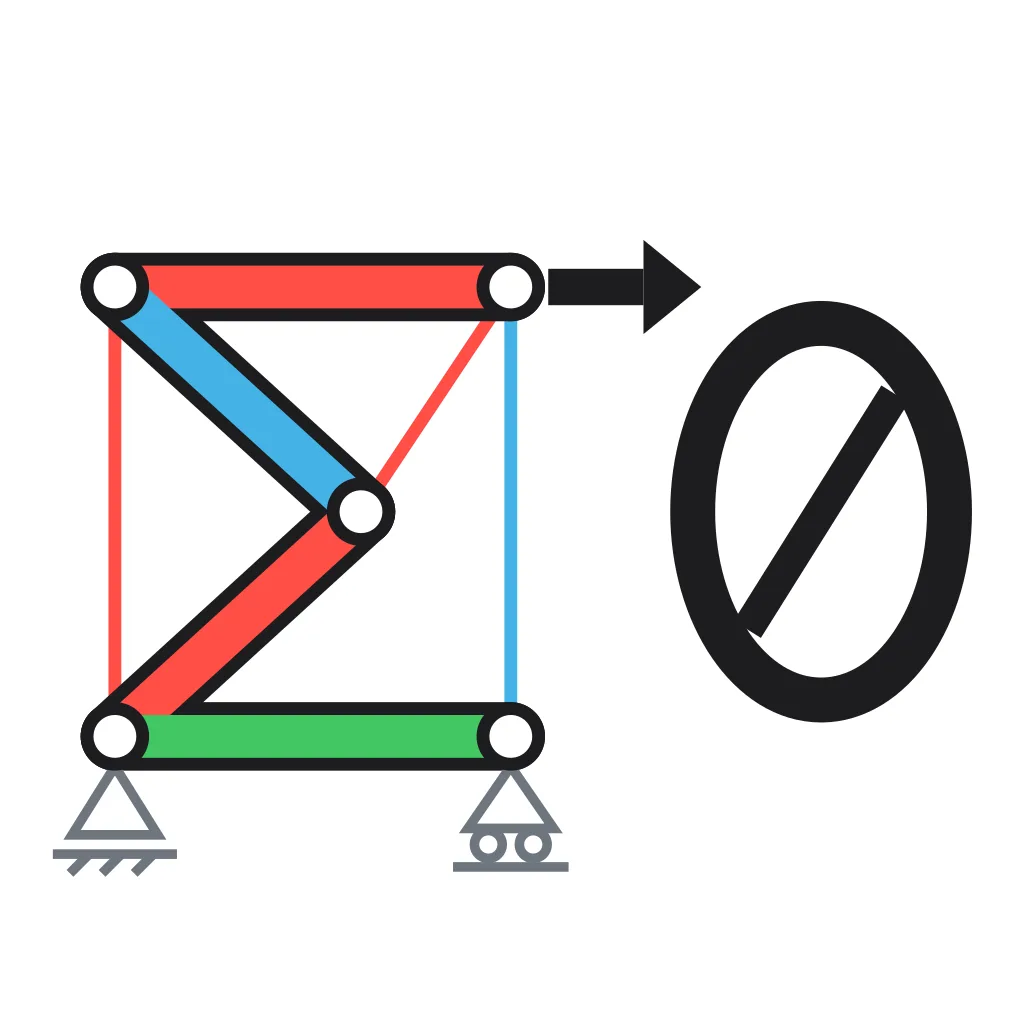
A free browser puzzle game about solving trusses the way an engineer does by hand. You look at a structure, place the reaction forces at the supports, choose the axis and the moment centre that make an unknown drop out, cut the truss to expose internal forces, and build the equilibrium equations (ΣFx = 0, ΣFy = 0, ΣM = 0) by tapping arrows on screen; the game does the arithmetic, and each solved unknown turns into a green number until tension and compression show on every rod. There are 61 levels, from a single rod to real-world trusses and challenge puzzles. It runs in the browser on phones, tablets and desktops, is designed for portrait play, and is in Japanese and English. The page says it collects and sends nothing, with no ads, accounts or analytics. The developer, Oborova Games, describes in a long Qiita post how it was made alone over 196 days and 952 commits: writing C# by hand for about a week with Gemini correcting it, then having Gemini write whole files, and from June 2026 running Claude Code agents, until in the last phase the developer no longer read the code at all. The developer adds that the core maths and engineering logic was largely finished while they were still reading every line, and that the later AI work was mostly screens and UI.
How it was built
Partially verifiedThe developer's Qiita post says Claude Code was brought in on 13 Jun 2026 after a two-month pause, first to diagnose the repository and build the missing title screen, level select and UI. From July it ran on a separate laptop with full permissions, drove Unity through Unity MCP and then uLoopMCP (compiles, tests, screenshots, automated play through a JSON test API), made its own commits, and ran in several parallel sessions. From August the developer organised it as a four-layer pyramid of agents (a manager on Claude Fable 5, engineers on Opus 5; on release day Fable 5.1 directly over Opus 5) and, in the developer's words, no longer followed a single line of C# in the editor. The developer kept the full play-through of all 61 levels as a personal task and finished it in the browser after making the game public.
- Developeritch.io AI disclosure: AI Assisted, with Code, Graphics and Text ticked. The page names no tool. — itch.io
Per the Qiita post, development started on 21 Feb 2026 with a consultation with Gemini (gemini-3.1-pro-preview) that led to choosing Unity. From 28 Feb the developer wrote C# by hand and had Gemini correct it; after about a week (from 7 Mar) Gemini wrote the screen-independent logic files whole, including the equation system and a finite-element solver used to check answers, which the developer reviewed and corrected on the physics. Into April Gemini produced diffs and then full files that the developer pasted in, over 15 chat sessions. Gemini was also used on release day to brainstorm the studio name.
Solo development in Unity over 196 days (21 Feb to 5 Sep 2026), with no activity for 56 days between mid-April and mid-June, per the developer's Qiita post. The developer moved through six stages: hand-written C# corrected by Gemini; Gemini writing diffs and whole files that the developer pasted in and read; Claude Code with the developer clicking through Unity for it; Claude Code controlling Unity from the command line via MCP and uLoopMCP; parallel Claude Code sessions; and finally a hierarchy of Claude agents with the developer reviewing play experience rather than code. Design rules lived in Markdown documents and a CLAUDE.md file. The post reports 157 C# files of about 41,100 lines, 277 test cases, 61 levels and a 22.4 MB WebGL build. The developer says the mathematical and engineering model layer was nearly complete, and fully understood by them, while they were still reading all of the code, and that AI's later work was mostly screen transitions and UI.
- Engine / framework
- Unity
- Languages
- C#
- Team size
- 1 (solo)Developer ReportedQiita (@Oborova)
- Development time
- 6 monthsDeveloper ReportedQiita (@Oborova)
- Development cost
- Not disclosed
- AI-written code
- Not disclosed
Verification notes: AI use from the developer's Qiita post of 5 Sep 2026 (14:11 UTC) and the itch.io AI disclosure (AI Assisted; Code, Graphics, Text). The post itself says it was drafted by AI (Fable 3.1, edited with Gemini 3.8 Flash) from the repository's development logs and git history, with the structure decided by the developer and some passages marked as the developer's own additions. Recorded as AI-assisted rather than vibe-coded: the developer wrote the first C# by hand, reviewed and corrected the AI-written logic files for months, and says the core model layer was finished and fully understood before they stopped reading code; no share of AI-written code is given. Figures (196 days, 952 commits, about 41,100 lines in 157 files, 277 tests) are the developer's and not independently checked. The 28-week development time is the 196 days stated, including a 56-day pause. Release date from the post (v1.0.0 made public on itch.io on 5 Sep 2026); the itch.io page shows no date. A simultaneous unityroom release was dropped the same evening because the localisation assets could not be uploaded there, so no unityroom listing exists. Features, 61 levels, devices, language switch and the no-data policy from the itch.io page; credits there list Unity, Noto Sans JP, Liberation Sans and Latin Modern fonts, Material Symbols icons, Math.NET Numerics and a sound by SND. What the AI-made graphics are is not stated. The developer's location is not stated. No ratings are shown on the page.
Development history
Development starts with a first consultation with Gemini about the technology to use.
DeveloperQiita (@Oborova)First git commit; hand-written code gives way to Gemini writing the logic files.
DeveloperQiita (@Oborova)Development resumes with Claude Code after a 56-day pause.
DeveloperQiita (@Oborova)Version 1.0.0 made public on itch.io as a free browser game, at commit 952.
DeveloperQiita (@Oborova)
Game performance
Each figure measures something different — concurrent players, owners, downloads and sales are never interchangeable and are never added together. Labels show where each number comes from.
itch.io
Free in the browser (HTML5). The page says there are no ads, no accounts and no analytics, and that progress is saved only in the browser.
No public metrics recorded for this listing.
Not publicly available: itch.io rating, Gross revenue.
Sales & revenue (all platforms)
Browser game — there are no downloads to count.
Reviews & rankings
Not yet reviewed by our editors.
Prototype: your vote is kept only in this browser and is not counted anywhere.
Not currently ranked.
No player reviews yet.
Prototype: reviews are stored in your browser only and are not published or sent to a server. Reviews are shown in the language they were written in.
Sources
| Source | Type | Published | Accessed |
|---|---|---|---|
| SigmaZero -truss puzzle by Oborova Games itch.io | Store page | Not confirmed | Nov 3, 2026 |
| 構造力学パズル「SigmaZero」を AI と作った 196 日・952 コミット—Unity教科書の勉強から Claude Code のエージェント組織運営まで Qiita (@Oborova) · Japanese | Devlog | Sep 5, 2026 | Nov 3, 2026 |
- How much of the code AI wrote
- The developer wrote C# by hand for about a week, then had Gemini write whole logic files that the developer read and corrected, and from August stopped reading the code that Claude Code agents wrote. The developer also says the core model layer was nearly finished and fully understood before that, and that AI's later work was mostly screens and UI. The itch.io disclosure ticks AI-generated code. No share is given, so the game is recorded as AI-assisted. (Qiita (@Oborova), itch.io)