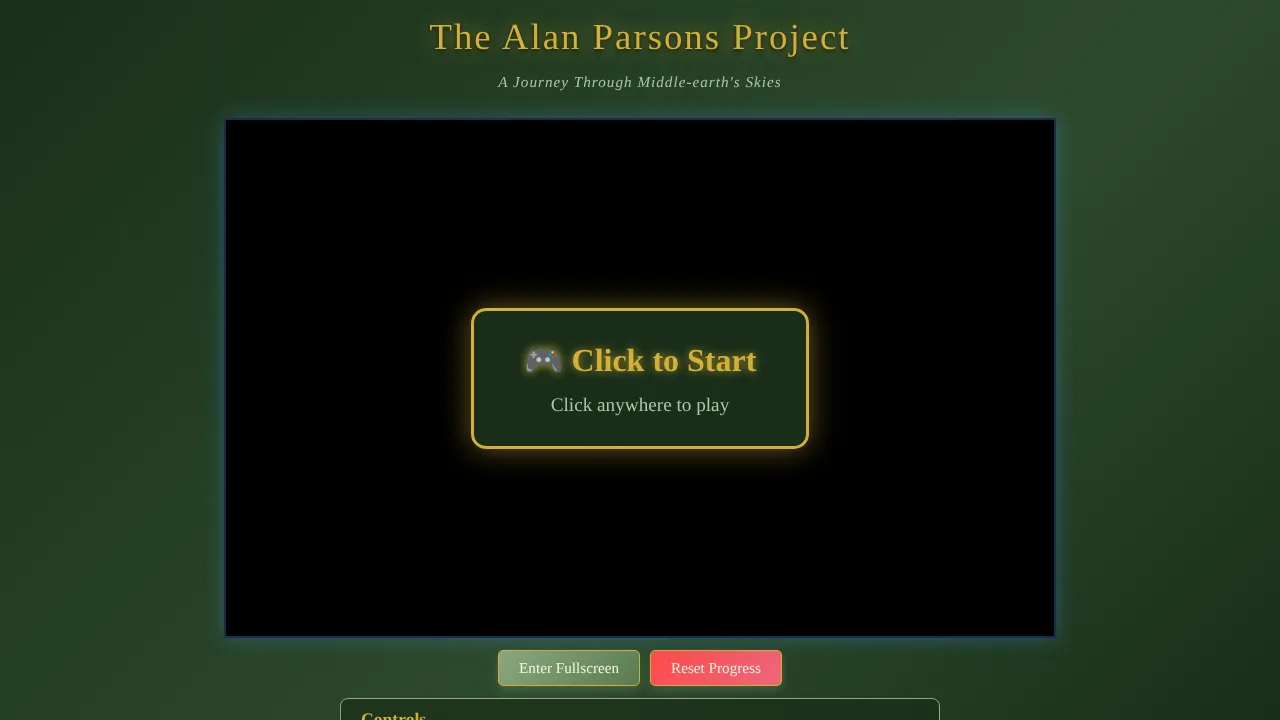
The Alan Parsons Project
A 2002 student space shooter written in x86 assembly, ported to C and WebAssembly with Claude Code so it plays in the browser again.
Official site particlefield.com, verified Nov 3, 2026. Linked from the developer's Show HN post, the write-up and the repository README.
Rights holder / original work: The Alan Parsons Project (band name); Middle-earth (J. R. R. Tolkien)
The game is the developers' own work, but its title uses the name of the band The Alan Parsons Project, its subtitle and levels refer to Tolkien's Middle-earth (the Shire, Mordor), other level files are named dune and midkemia, and an invincibility mode is called Captain Planet Mode. No source mentions a licence for these names, and the origin of the soundtrack files is not stated. (ParticleField.com)
VibeGameDB lists this game only to document that it was made with AI coding tools. We do not host it, we do not represent the rights holder, and listing it does not mean it is licensed.
Where to play
Every platform this game is on. Links are checked against official sources; we never host or mirror games.
- Play free — official siteBrowserReleased · Port of the developers' own 2002 gameFree
Runs in a desktop or mobile browser. No download.
Browser (no download) · Mobile · Official link verified Nov 3, 2026.
- View on GitHubGitHubReleased · C source with native SDL2 and WebAssembly builds; no licence file foundFree
Source code repository, not a place to play.
Official link verified Nov 3, 2026.
About The Alan Parsons Project
A particle-heavy space (or sky) shooter that four students and a younger brother wrote in x86 assembly in under two weeks as their final project for ECE 291 at the University of Illinois in 2002. It is a port of their own game, not of someone else's: you fly a ship over wrap-around maps through six levels, from the Shire to Mordor, each ending in a boss fight, with weapons that upgrade as you go, six nukes per level that clear the screen with a shockwave, and up to 10,000 particles at once. Twenty-three years later Benjamin Gottemoller had Claude Code port the assembly to C and then compiled it to WebAssembly with Emscripten; the developer says a first attempt at translating x86 straight to WebAssembly passed hundreds of unit tests but kept crashing, and the route through C worked. It plays free in desktop and mobile browsers, with twin-stick touch controls on phones, an optional invincibility mode called Captain Planet Mode, and the C source is on GitHub.
How it was built
VerifiedThe developer's write-up says Claude Code got them past the effort that kept the team from old projects, and that they burned the tokens needed to port the assembly game to C, generate WebAssembly with Emscripten and wrap it in tests. In the Show HN thread the developer says it took “a pile of Opus 4.6 tokens” and that a first attempt with a direct x86-to-WebAssembly transpiler was dropped. The game's design, art and original assembly code are from 2002; the repository README also lists a 2026 architecture refactoring, body collisions, balance tuning and mobile controls; one commit of 13 Feb 2026 is titled “Claude generated mobile fix”, and the other commits do not say who wrote the changes.
- DeveloperShow HN thread: the developer ported the assembly to C with Opus 4.6, then compiled it to WebAssembly via Emscripten. — Hacker News (gottebp)
- DeveloperGame page, About: the assembly was ported to C with the help of Claude Code and compiled to WebAssembly via Emscripten. — ParticleField.com
The 2002 x86 assembly (hand-tuned SSE memory operations, a Mersenne Twister random number generator, toroidal map physics, software rendering) was ported to C with SDL2 by Claude Code, wrapped in tests and compiled to WebAssembly with Emscripten. The repository describes a later clean-architecture refactoring with explicit state passing and pool-based entities. The game data (map bitmaps, sprites, six soundtrack files and sound effects) comes from the original project.
- Engine / framework
- No engine (C with SDL2; WebAssembly via Emscripten)
- Languages
- C
- Team size
- Not disclosed
- Development time
- Not disclosed
- Development cost
- Not disclosed
- AI-written code
- Not disclosed
“Claude Code has a way of overcoming that activation energy that used to keep us from the old projects.”- Show HN: An x86 assembly game from 2002, ported to WebAssembly with Claude Code
- Some projects stick with you longer than they should (LinkedIn)
- gottebp/alan_parsons_project on GitHub
Verification notes: What the game is: the developers' own ECE 291 final project from 2002 at the University of Illinois, written in x86 assembly, not a port of another studio's game; the name borrows the band name The Alan Parsons Project. Sources: the developer's LinkedIn write-up of 14 Feb 2026 (names Claude Code), the Show HN post of 15 Feb 2026 (00:41 UTC) and the developer's first comment on it (names Opus 4.6 and the dropped transpiler approach), the game page and the repository README. Gameplay facts (six levels with bosses, auto-upgrading weapons, six nukes per level, body collisions, mobile twin-stick controls, Captain Planet invincibility mode) are from the README and the game page. Level files in the browser build are named shire, mordor, dune, midkemia, oceania and archipelago; the write-up describes the six levels as going from the Shire to Mordor. The origin of the six soundtrack files is not stated. No licence file was found in the repository. Team size for the port is not stated (the write-up says “I”, while the game is credited to five people), so none is recorded. GitHub statistics could not be read from the research environment.
Development history
- 2002
Written in x86 assembly in under two weeks as a final project for ECE 291 at the University of Illinois; an SDL port for Linux and Windows follows the same year.
The developer publishes a write-up on bringing the game back with Claude Code, linking the browser version.
DeveloperLinkedIn (Benjamin Gottemoller)Posted on Hacker News as a Show HN.
OfficialHacker News (gottebp)
Game performance
Each figure measures something different — concurrent players, owners, downloads and sales are never interchangeable and are never added together. Labels show where each number comes from.
Browser (official site)
Free in the browser; keyboard on desktop and twin-stick touch controls on phones (landscape).
No public metrics recorded for this listing.
Not publicly available: Concurrent players (site), Monthly revenue, Gross revenue.
GitHub
No public metrics recorded for this listing.
Not publicly available: GitHub stars.
Sales & revenue (all platforms)
Browser game — there are no downloads to count.
Reviews & rankings
Not yet reviewed by our editors.
Not currently ranked.
Sources
| Source | Type | Published | Accessed |
|---|---|---|---|
| Show HN: An x86 assembly game from 2002, ported to WebAssembly with Claude Code Hacker News (gottebp) | Social post | Feb 15, 2026 | Nov 3, 2026 |
| Some projects stick with you longer than they should. LinkedIn (Benjamin Gottemoller) | Devlog | Feb 14, 2026 | Nov 3, 2026 |
| The Alan Parsons Project (game page) ParticleField.com | Official site | Not confirmed | Nov 3, 2026 |
| gottebp/alan_parsons_project — README GitHub (gottebp) | Repository | Not confirmed | Nov 3, 2026 |
| Official game page (language check) ParticleField.com | Official site | Not confirmed | Nov 3, 2026 |
- Year of the C port
- The game page says the assembly was ported to C “in 2024”; the repository README lists the C port under 2026, the Show HN comment describes it as done twenty-three years after 2002 with Opus 4.6, and the repository's first commit, titled as the x86 ASM to C/WASM port, is dated 4 Dec 2025. (ParticleField.com, GitHub (gottebp), Hacker News (gottebp))