점심 방송
A phone-first walk-around story game for intermediate learners of Korean, set at a fictional high school, where every word is tappable; the developer calls it vibecoded and had Claude write the story and definitions.
Official site stan-stani.github.io, verified Nov 3, 2026. Linked from the developer's own Show HN post and as “Play” in the README of the developer's repository.
Where to play
Every platform this game is on. Links are checked against official sources; we never host or mirror games.
- Play free — official siteBrowserReleased · In ongoing development; four chapters, of which the developer had played through two at the time of the Show HN postFree
Runs in a desktop or mobile browser. No download.
Browser (no download) · Mobile · Official link verified Nov 3, 2026.
- View on GitHubGitHubReleased · Source code (MIT licence)Free
Download from the GitHub releases page.
Desktop · Official link verified Nov 3, 2026.
About 점심 방송
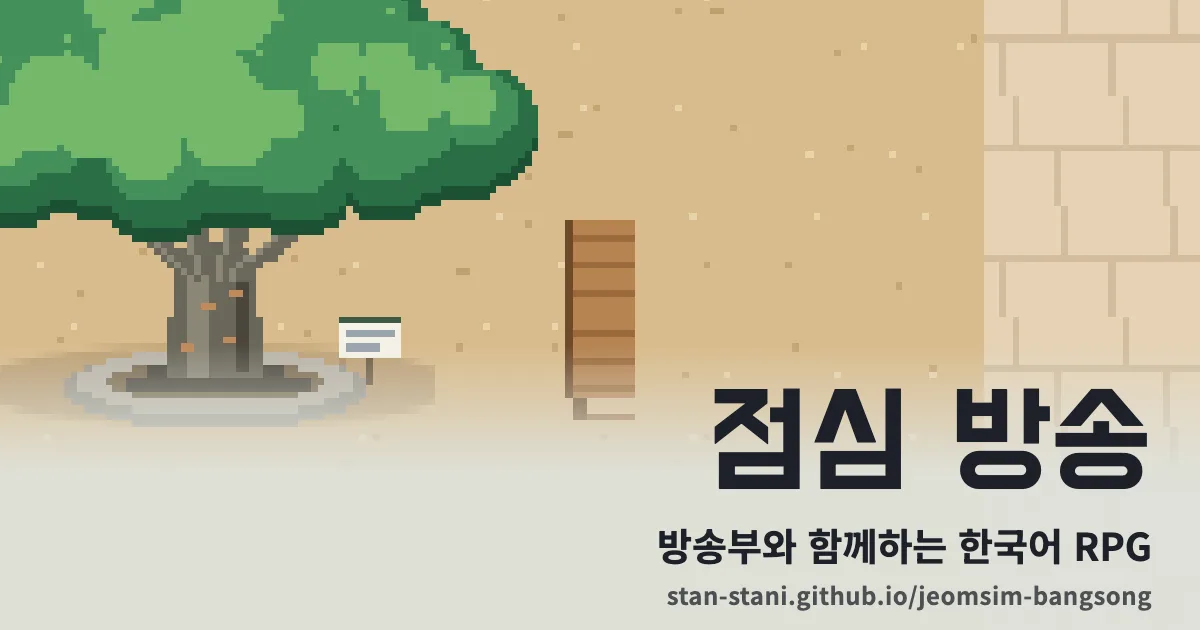
점심 방송 (Lunchtime Broadcast) is a free browser game for learning Korean, built for phones and playable with a keyboard. You are a transfer student at a fictional high school, 느티고, who is pulled into the broadcast club on the first day: the club has until the school festival to find five members or its room becomes a classroom, and pink notes signed “복숭아” keep turning up. The story runs over four chapters, one per class period (교시), and you move it on by walking around the school and talking to people, a style the developer likens to Homestuck. Dialogue is in Korean only, in short sentences; tap any word for a simpler Korean definition, with English for the word and the whole line behind a “?”. People with a “!” teach new words through quizzes and word-order puzzles, and learned words return as spaced-repetition questions asked in character during the story. The menu holds a conversation log, a dictionary of looked-up words, read-aloud, listening questions and culture and grammar notes that cite their sources. The vocabulary comes from the first four free episodes of the webtoon “Sora & Haena!”, pitched at the developer's own level (about TOPIK 3); the story, cast and places are original, and the README says no text, names, scenes or images from the webtoon are included. The developer, Stan-Stani on GitHub (EstanislaoStan on Hacker News), calls the game vibecoded and says Claude wrote the original story, the Korean lines and the learner definitions and generated the culture and grammar notes, and the developer warns that the Korean was not written by native speakers. Development is ongoing. Free, with the source on GitHub under the MIT licence.
How it was built
Partially verifiedThe developer's Show HN post is titled “Vibecoded top-down game for learning vocab from a Korean webtoon”. In it the developer says they had Claude come up with its own original story that teaches the webtoon's vocabulary at their level; every tappable word has a definition “Claude wrote in simpler Korean”; the culture and grammar notes were generated by Claude and fact-checked against online sources; and the Korean lines were generated by Claude, not by native speakers. Development is ongoing and involves having Claude Opus 5.5 and GPT 6.1 Sol play through the chapters several times as players in polishing passes, alongside the developer's own play-throughs. The post does not say in so many words which tool wrote the game's code, or whether any of it was written by hand.
- UnverifiedThe repository has a CLAUDE.md file of working rules for agents (which source files to edit and which generated files never to edit by hand, build checks, automated playtests, a limit of two agents playtesting at once); it does not name the tool, and the developer has not said which tool wrote the code. — GitHub (Stan-Stani)
Built around a story Claude wrote to teach the vocabulary of the webtoon's first four episodes, one chapter per episode, with the developer's feedback from playing. Per the README, the chapters, the school map, the culture and grammar notes and a tap-a-word dictionary live as JavaScript and JSON source files that a Python build script assembles into a single HTML page for GitHub Pages; the engine is generated from the developer's shared walk engine. Checks include a validator for maps, doors, words and citations, a dictionary coverage check and headless-browser playtests that play each chapter by key presses on a phone-sized screen. The word list is built from local tallies that are never committed, so no webtoon text is in the public repository. Read-aloud uses the browser's speech feature; the game does not call an AI service while you play.
- Engine / framework
- No engine of its own (the developer's shared walk engine; single HTML file)
- Languages
- JavaScript
- Team size
- 1 (solo)Developer ReportedHacker News (EstanislaoStan)
- Development time
- Not disclosed
- Development cost
- Not disclosed
- AI-written code
- Not disclosed
“I had Claude come up with its own original story that teaches vocab from the webtoon's first 4 episodes, but is targeted to my intermediate-ish level.”- Show HN: Vibecoded top-down game for learning vocab from a Korean webtoon
- Stan-Stani/jeomsim-bangsong on GitHub
Verification notes: The AI claims come from the developer's Show HN post of 12 Oct 2026 (18:16 UTC): the title calls the game vibecoded, and the post says Claude wrote the story, the Korean lines and the definitions, generated the culture and grammar notes, and that Claude Opus 5.5 and GPT 6.1 Sol play-test the chapters; the model names are quoted as the developer wrote them. No sentence names the tool that wrote the code, so the record relies on the developer's description of the game as vibecoded; the CLAUDE.md file is kept only as unverified evidence. Story, chapters, features and the webtoon note come from the README; the repository's CLAUDE.md says it was renamed from banghu on 10 Oct 2026. The developer's name is taken from the MIT licence (“Copyright (c) 2026 Stan Stanislaus”). The webtoon is named only in the post; the README says only “a school-life webtoon”. Using a webtoon's word list is not use of its names, characters or art, and the README says none are included, so no IP note is recorded. The repository's commit history could not be read, so no release date is recorded. Location is not stated. The game was not played through.
Development history
The repository is renamed from banghu to jeomsim-bangsong.
DeveloperGitHub (Stan-Stani)The developer posts the game on Hacker News as a Show HN; at that point the developer had played through two of its four chapters.
OfficialHacker News (EstanislaoStan)
Game performance
Each figure measures something different — concurrent players, owners, downloads and sales are never interchangeable and are never added together. Labels show where each number comes from.
Browser (official site)
Free in the browser; no payment or account.
No public metrics recorded for this listing.
Not publicly available: Concurrent players (site), Monthly revenue, Gross revenue.
GitHub
No public metrics recorded for this listing.
Not publicly available: GitHub stars.
Sales & revenue (all platforms)
Browser game — there are no downloads to count.
Reviews & rankings
Not yet reviewed by our editors.
Not currently ranked.
Sources
| Source | Type | Published | Accessed |
|---|---|---|---|
| Show HN: Vibecoded top-down game for learning vocab from a Korean webtoon Hacker News (EstanislaoStan) | Social post | Oct 12, 2026 | Nov 3, 2026 |
| Stan-Stani/jeomsim-bangsong — README GitHub (Stan-Stani) | Repository | Not confirmed | Nov 3, 2026 |
| Stan-Stani/jeomsim-bangsong — CLAUDE.md GitHub (Stan-Stani) | Repository | Not confirmed | Nov 3, 2026 |
| Stan-Stani/jeomsim-bangsong — LICENSE GitHub (Stan-Stani) | Repository | Not confirmed | Nov 3, 2026 |
| 점심 방송 · 방송부와 함께하는 한국어 RPG Stan-Stani (GitHub Pages) | Official site | Not confirmed | Nov 3, 2026 |