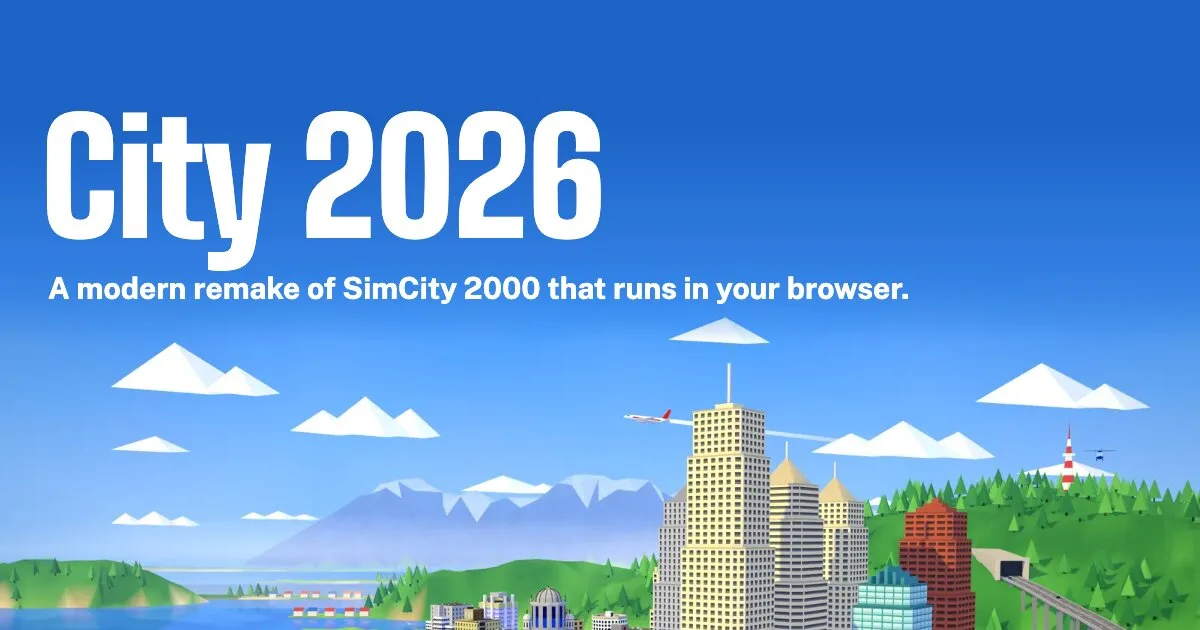
City 2026
SimCity 2000 rebuilt for the browser in low-poly 3D: Claude Opus 5.5 translated the original Mac game's decompiled code function by function.
Official site city2026.app, verified Nov 3, 2026. Linked from the developer's own site dator.dev; the Show HN address dator.dev/city2026 now redirects to city2026.app/play/, and the game credits link to github.com/drdator and dator.dev.
Rights holder / original work: SimCity 2000 (Maxis / Electronic Arts)
A remake of SimCity 2000 whose game logic, by the developer's account, was produced by decompiling the original Mac version and translating its PowerPC code function by function. The site says SimCity and SimCity 2000 are trademarks of Electronic Arts, that the game is an independent fan project not affiliated with or endorsed by Electronic Arts or Maxis, and that it contains none of the original's art, sound or music; it does reproduce the original's interface, menus and help texts. No source shows a licence from Electronic Arts. (Einar Andersson (drdator))
VibeGameDB lists this game only to document that it was made with AI coding tools. We do not host it, we do not represent the rights holder, and listing it does not mean it is licensed.
Where to play
Every platform this game is on. Links are checked against official sources; we never host or mirror games.
- Play free — official siteBrowserReleasedFree
Runs in a desktop or mobile browser. No download.
Browser (no download) · Mobile · Official link verified Nov 3, 2026.
About City 2026
City 2026 is a free browser remake of SimCity 2000 (1993). You zone land, lay roads and power lines, set taxes and ordinances, handle bonds, neighbours, scenarios and every disaster, and read a newspaper that reports on your city. The developer, Einar Andersson (drdator), says the starting prompt asked for a full replica of the original game's logic, and Anthropic's Claude Opus 5.5 decompiled the Mac version with Ghidra and translated its PowerPC code into TypeScript function by function, then checked the result against the original running in an emulator. The look is new: all 255 building tiles are remade as low-poly 3D models after the original pictures, with the original isometric view, toolbars and menus, plus an optional perspective sightseeing camera, smog, a sky, depth of field and natural landscapes. The site says it contains none of the original game's art, sound or music; the music is by Kevin MacLeod under CC BY 4.0 and the sounds come from Freesound. Old .SC2 save files from the Mac, DOS and Windows versions load and save in the same format. Free, nothing to install; best with a mouse, with touch controls on tablets and phones held sideways.
How it was built
VerifiedThe developer says the game was built with Claude Opus 5.5 over a few days, starting from one prompt asking for a TypeScript WebGL low-poly version of SimCity 2000 with a full replica of its game logic, with the original game supplied for inspection. According to the developer, Opus decompiled the original with Ghidra and translated the native PowerPC code function by function; after about two hours, with 27 subagents, a version was running in the browser. After a follow-up prompt to make sure every part was implemented accurately, Opus wrote a Python harness that ran the original code in the Unicorn emulator with faked Mac system calls, and checked that 10,000 game days produced an identical game state. The developer says Opus also generated all 3D and vector assets in code; the bitmap images were made with GPT Image 2 (OpenAI). The coding interface (for example Claude Code) is not named.
A TypeScript and WebGL game whose simulation, by the developer's account, is a function-by-function translation of the decompiled PowerPC code of the Mac version of SimCity 2000, verified against the original running in an emulator. Everything the player sees is new: 3D and vector assets generated in code, bitmap images from GPT Image 2, Creative Commons music by Kevin MacLeod and sounds from Freesound. The developer says AI audio models were not used because they sounded bad. After the first working build the developer spent the time on polish and a few modern touches (smog, depth of field and ambient sound).
- Engine / framework
- No engine (TypeScript and WebGL)
- Languages
- TypeScript, Python
- Team size
- Not disclosed
- Initial build time
- About 2 hours to a running browser build, using 27 subagentsDeveloper ReportedHacker News (drdator)
- Development time
- Not disclosed
- Development cost
- Not disclosed
- AI-written code
- Not disclosed
“I created this because I wanted it and to see how capable Opus 5.5 was. It turned out much better than expected, so I figured I'd share it.”Verification notes: Model, method (decompilation with Ghidra, translation of the PowerPC code, Unicorn-based verification), timings, subagent count and asset sources from the developer's Show HN post of 6 Oct 2026 and a reply in that thread about the depth-of-field setting. Features, the trademark statement and the music and sound credits from the game's site, city2026.app, which the developer's site dator.dev lists as City 2026. The Show HN link dator.dev/city2026 now redirects to city2026.app/play/. The game's code links only to its credits pages, and no calls to AI services were found. Python is recorded as a language because the developer says the verification harness was written in Python. The release day is not stated; the Show HN post says the game was built over a few days before 6 Oct 2026. The post is written in the first person; team size is not stated. No development cost is given (two HN commenters asked; no answer in the thread). IP: by the developer's own account the simulation code is translated from the decompiled code of SimCity 2000's Mac version, which is a commercial game; the site says the game contains none of the original's art, sound or music, but it states that it reproduces the original's interface, menus and help texts and loads original .SC2 files. One HN commenter pointed out that letting the agents read the old code directly is not a clean-room reimplementation, and another said the project has legal challenges. No source shows a licence from Electronic Arts or Maxis. Location is not stated.
Development history
- Early October 2026
Built over a few days: one prompt starts the decompilation and function-by-function translation, and a first build runs in the browser after about two hours with 27 subagents.
DeveloperHacker News (drdator) Shown on Hacker News by the developer as a Show HN post at dator.dev/city2026.
DeveloperHacker News (drdator)- By November 2026
Moved to its own site, city2026.app, which calls it a modern remake of SimCity 2000; the old address redirects there.
ObservedEinar Andersson (drdator)
Game performance
Each figure measures something different — concurrent players, owners, downloads and sales are never interchangeable and are never added together. Labels show where each number comes from.
Browser (official site)
Free, nothing to install. Best on a computer with a mouse; touch controls on tablets and phones held sideways.
No public metrics recorded for this listing.
Not publicly available: Concurrent players (site), Monthly revenue, Gross revenue.
Sales & revenue (all platforms)
Browser game — there are no downloads to count.
Reviews & rankings
Not yet reviewed by our editors.
Prototype: your vote is kept only in this browser and is not counted anywhere.
Not currently ranked.
No player reviews yet.
Prototype: reviews are stored in your browser only and are not published or sent to a server. Reviews are shown in the language they were written in.
Sources
| Source | Type | Published | Accessed |
|---|---|---|---|
| City 2026: a modern remake of SimCity 2000 Einar Andersson (drdator) | Official site | Not confirmed | Nov 3, 2026 |
| Show HN: A modern low-poly SimCity 2000 clone, built by Opus 5.5 Hacker News (drdator) | Devlog | Oct 6, 2026 | Nov 3, 2026 |
| dator.dev — Einar Andersson Einar Andersson | Official site | Not confirmed | Nov 3, 2026 |
| Official game page (language check) Einar Andersson (drdator) | Official site | Not confirmed | Nov 3, 2026 |