TET~CRAFT: The Fourth Temple
An experimental physics sandbox: spawn tetrahedrons as “facts”, join them into shapes and molecules inside a Klein-bottle universe, and share them with friends over a direct connection.
Links go to the official store or developer page. Last verified Nov 3, 2026.
Where to play
Every platform this game is on. Links are checked against official sources; we never host or mirror games.
- View on SteamSteamReleased$33.33
Download through the Steam app. A free Steam account is required.
Desktop · Steam
- View on GitHubGitHubReleased · Source code; runs with Python (Apache 2.0 per the README)Free
Download from the GitHub releases page.
Desktop · Official link verified Nov 3, 2026.
About TET~CRAFT: The Fourth Temple
TET~CRAFT: The Fourth Temple is an experimental sandbox simulation written in Python. Pressing the space bar creates a TET, a tetrahedron that stands for a fact; you label TETs with a right click and drag their corners onto other corners to join them, or leave them alone and let some join by themselves, building shapes, stories, concepts or examples. The notes in the source code describe a chemistry layer in which locked faces and colour patterns identify more than 100 molecule types, molecules react with one another and catalysts speed up nearby reactions. The world is what the developer calls a 5D Klein-space: a 3-sphere around your creation shows reflected past alternatives that look like stars, and ahead lies a black hole that everything is drawn towards. You can speed time up or slow it down, look from any angle and save snapshots called “instants” that other players can load in full. You can chat with friends over a direct WAN connection that the store page calls unlimited, unrestricted and unsecured, and a built-in bot tries to make sense of your creation. The store text frames the game in religious and metaphysical terms; it opens “Be a young god learning”. In the Steam AI disclosure the developer says most of the source code was vibe coded, though it is getting too complex for the better models and the developer has done a lot of personal touch-ups, and that all marketing was AI-generated except the screenshots and the demo video. The header of the game's main source file credits Gemini 2.5 with writing the program, Gemini 3.0 with the black hole and a Gradio version, DeepSeek with the chemistry, Opus 4.5 with the accretion disk and chemical colours, and GPT-4o with a physics and thermodynamics refinement (“Whitepaper v1.0”). US$33.33 on Steam for Windows and Linux since 15 Feb 2026, with a free demo; the source code is public on GitHub, and the README says everything is under the Apache 2.0 licence.
Screenshots and art
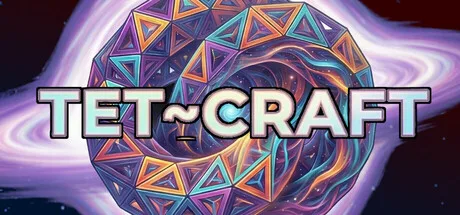
TET~CRAFT: The Fourth Temple key art · Steam store artwork
How it was built
Partially verifiedThe header of the game's main source file (app.py, version v5.3D, in the developer's repository) says the program was “Written by Gemini 2.5”, that the black hole was “revised by Gemini 3.0” and the Gradio version “implemented by Gemini 3.0”, and that the “Entire project” was “Vibe coded by ceneezer”. It does not say whether the Gemini app, Gemini CLI or another product was used. The same header credits DeepSeek with adding the chemistry (“~v3.3?”) and GPT-4o with a “Physics & Thermodynamics Refinement (Whitepaper v1.0)”, without saying whether GPT-4o wrote code for it; DeepSeek has no tool entry here.
- DeveloperSteam AI disclosure: “Most source code was vibe coded, though it's getting too complex for the better models and I've done a lot of personal touch-ups.” — Steam
The same source header says the accretion disk and chemical colours were “beautified by Opus 4.5”. It does not say which Claude product was used.
Per the Steam disclosure, most of the source code was vibe coded, with the developer making many touch-ups as the code grew too complex for the models; per the source header, different models wrote or reworked different parts (Gemini 2.5 the program, Gemini 3.0 the black hole and the Gradio version, DeepSeek the chemistry, Opus 4.5 the accretion disk and colours). The game is a single Python file using pygame, NumPy, Numba and SciPy, with Gradio for an optional Hugging Face version; the repository keeps older versions of the file.
- Engine / framework
- pygame (Python)
- Languages
- Python
- Team size
- Not disclosed
- Development time
- Not disclosed
- Development cost
- Not disclosed
- AI-written code
- Not disclosed
“Most source code was vibe coded, though it's getting too complex for the better models and I've done a lot of personal touch-ups.”Verification notes: The AI claim rests on the developer-written AI disclosure on the game's Steam page (re-read on 4 Nov 2026), which says most of the source code was vibe coded, and on the header of app.py in the developer's public repository (main branch, read on 4 Nov 2026), which names the models: Gemini 2.5 and 3.0, DeepSeek, Opus 4.5 and GPT-4o. Gemini and Claude are recorded as named, without a product; DeepSeek and GPT-4o (credited with a physics and thermodynamics refinement, “Whitepaper v1.0”, which app.py implements in sections marked “Whitepaper”; the header does not say whether GPT-4o wrote that code) appear in the usage text only. Steam lists the repository's README as the game's website. The in-game bot is a scripted class in app.py (BotMind) that reacts to nearby molecules; a search of app.py found no calls to an AI model or online AI service, so nothing is generated by AI during play. The store text compares the game to a construction toy and the README to Minecraft; these are the developer's comparisons, and no third-party names or assets were seen in the game's description of itself. The README and store text include long religious and personal commentary, which we do not summarise. Release date, price, platforms and language from the Steam store API, the demo date from the demo's own store entry; the review count from the store page on 4 Nov 2026. A Hugging Face Space named in the README was not checked. Team size and location are not stated.
Development history
Game performance
Each figure measures something different — concurrent players, owners, downloads and sales are never interchangeable and are never added together. Labels show where each number comes from.
Steam
US$33.33 on the Steam store API (US region) on 4 Nov 2026. Windows and Linux; a free demo (TET~CRAFT v4 Demo) has been on Steam since 28 Jan 2026.
All reviews as shown on the store page on 4 Nov 2026; Steam shows no score until a game has 10 reviews.
Not publicly available: Concurrent players, Positive Steam reviews, Estimated owners, Copies sold, Gross revenue.
GitHub
No public metrics recorded for this listing.
Not publicly available: GitHub stars.
Reviews & rankings
Not yet reviewed by our editors.
Not currently ranked.
Sources
| Source | Type | Published | Accessed |
|---|---|---|---|
| TET~CRAFT: The Fourth Temple on Steam (store page incl. AI Generated Content Disclosure) Steam | Store page | Not confirmed | Nov 3, 2026 |
| TET~CRAFT v4 Demo on Steam (store API entry) Steam | Store page | Not confirmed | Nov 3, 2026 |
| ceneezer/Tet-craft README GitHub | Repository | Not confirmed | Nov 3, 2026 |
| ceneezer/Tet-craft app.py (release header, v5.3D) GitHub | Repository | Not confirmed | Nov 3, 2026 |