Inkmaru
A three-turn ink duel in the browser: both players draw a circle at the same time, big and faint or small and dense, and the denser ink takes the ground. The developer says the implementation is done with Claude Code.
Official site inkmaru.e17.click, verified Nov 3, 2026. Linked as the play link (遊ぶ) in the README of the developer's morststs/inkmaru-web repository and in the developer's Qiita article.
Where to play
Every platform this game is on. Links are checked against official sources; we never host or mirror games.
- Play free — official siteBrowserReleasedFree
Runs in a desktop or mobile browser. No download.
Browser (no download) · Mobile · Official link verified Nov 3, 2026.
- View on GitHubGitHubReleased · Browser-side source only (MIT licence); the signaling server is not includedFree
Download from the GitHub releases page.
Desktop · Official link verified Nov 3, 2026.
About Inkmaru
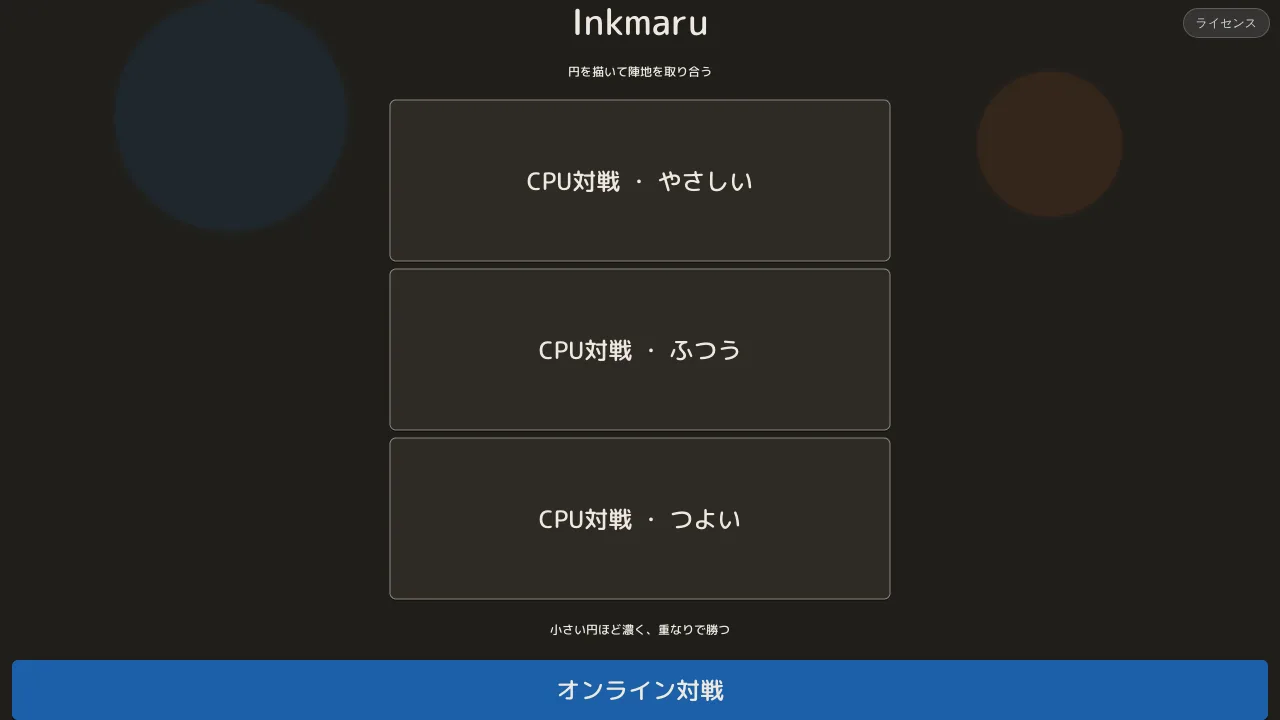
Inkmaru is a free one-on-one territory game in the browser, written in Go with Ebitengine and served as WebAssembly. A match lasts three turns. Each turn both players secretly draw one circle on the board with the same amount of ink: a large circle spreads the ink thin and wide, a small one keeps it dense and narrow. Where circles overlap, the denser ink wins the area; equal density leaves it neutral, shown as stripes. After three turns the player with more territory wins, so the game is about guessing whether your opponent will go wide or strike dense into your ground. You can play the computer at three levels (やさしい, ふつう, つよい) or play online: one player creates a room, tells the other its six-character room number by some other means, and after a match both can rematch, with a running record. The look follows an ink-and-paper theme, and the developer says the territory colours were chosen by measured colour difference so that players with different colour vision can tell them apart. The developer says the implementation, including the online mode and rematches, is done with Claude Code. The browser-side source is public under the MIT licence.
How it was built
Partially verifiedIn a Qiita article (Japanese, 18 Oct 2026) about adding peer-to-peer online play and rematches to what had been a computer-only game, the developer writes: “実装は Claude Code を使って進めています” (the implementation is being done with Claude Code). The article does not say how much of the code Claude Code wrote or how the work was split; the rest of it covers the developer's own design decisions and measurements.
Go with Ebitengine, compiled to WebAssembly (about 26 MB, about 4.4 MB with Brotli) and served from S3 and CloudFront. The rules, the computer player and the display logic do not depend on Ebitengine, so they are tested without a screen. Online play uses WebRTC data channels through pion/webrtc rather than the browser API, with a serverless signaling server (API Gateway WebSocket, Lambda, DynamoDB) that only relays connection details. Because both players move at once with no referee, a commit-reveal scheme stops anyone from waiting to see the other's move, and a board hash is compared every turn to catch mismatches; leaving a match counts as a loss. There is no TURN relay, so some networks cannot connect, and after 30 seconds the game says so and offers the computer instead. The on-screen font is a subset of M PLUS Rounded 1c (SIL OFL 1.1).
- Engine / framework
- Ebitengine (Go, compiled to WebAssembly)
- Languages
- Go
- Team size
- Not disclosed
- Initial build time
- Not disclosed
- Development time
- Not disclosed
- Development cost
- Not disclosed
- AI-written code
- Not disclosed
“CPU 対戦だけだったところに、WebRTC による P2P のオンライン対戦と、同じ相手との再戦を足しました。実装は Claude Code を使って進めています。”Verification notes: AI use from one sentence in the developer's Qiita article of 18 Oct 2026, which links the play page and the repository; it says the implementation is done with Claude Code but gives no share of AI-written code, so this is a weaker statement than “all the code was written by AI”. The developer's other recent Qiita posts describe apps that Claude Code was asked to make, but they are not about this game. Rules, modes, the online design and package layout from the article and the repository README (read as a raw file). The play page (page language ja) loaded on 4 Nov 2026; its comments say the full repository is private and only the browser side is published. The LICENSE names the copyright holder as morisy2. Team size, location and release date are not stated. The computer opponent is ordinary game code (internal/ai), not generative AI. The game was not played.
Development history
The developer publishes an article on Qiita about adding peer-to-peer online play and rematches, which had been computer-only before.
DeveloperQiita (morststs)
Game performance
Each figure measures something different — concurrent players, owners, downloads and sales are never interchangeable and are never added together. Labels show where each number comes from.
Browser (official site)
No public metrics recorded for this listing.
Not publicly available: Concurrent players (site), Monthly revenue, Gross revenue.
GitHub
No public metrics recorded for this listing.
Not publicly available: GitHub stars.
Sales & revenue (all platforms)
Browser game — there are no downloads to count.
Reviews & rankings
Not yet reviewed by our editors.
Not currently ranked.
Sources
| Source | Type | Published | Accessed |
|---|---|---|---|
| Go + WASM のブラウザ対戦ゲームに WebRTC を入れて分かったこと Qiita (morststs) · Japanese | Devlog | Oct 18, 2026 | Nov 3, 2026 |
| morststs/inkmaru-web — README GitHub (morststs) · Japanese | Repository | Not confirmed | Nov 3, 2026 |
| Inkmaru morststs · Japanese | Official site | Not confirmed | Nov 3, 2026 |
| Official game page (language check) morststs | Official site | Not confirmed | Nov 3, 2026 |
Similar games