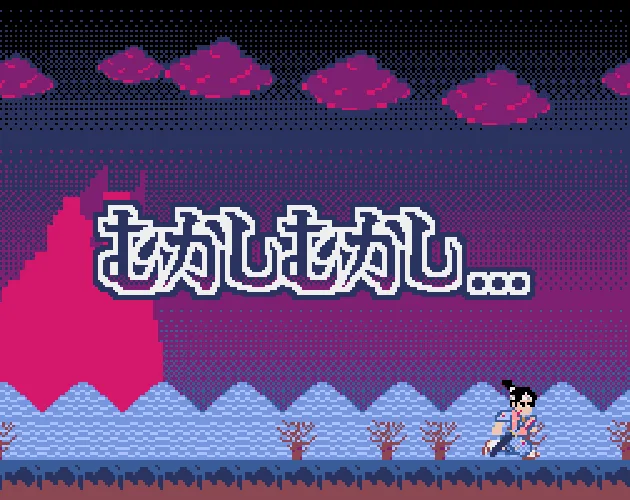
むかしむかし...
Play Momotaro on the run from the oni in a pixel-art runner roguelite: slash, jump, shield and stack skills to escape as far as you can.
Official site kaieda.itch.io, verified Nov 3, 2026. The developer's own itch.io page (kaieda), linked from the developer's note.com article.
Where to play
Every platform this game is on. Links are checked against official sources; we never host or mirror games.
- Play free — itch.ioitch.ioEarly access · Listed as “Prototype” on itch.ioFree
Plays in the browser on itch.io. No download.
Browser (no download) · Mobile · Official link verified Nov 3, 2026.
About むかしむかし...
むかしむかし... (Once upon a time...) is a free pixel-art run-action roguelite in the browser, built on the Japanese folk tale of Momotaro. The itch.io page sets it in a story the old tale never told: Momotaro has lost to the oni and is fleeing them. You run on with simple controls, jumping, attacking and raising a shield, cutting down the small oni that close in; enemy spawns and difficulty change with the distance you have covered, and at each level-up you pick one of three skills, such as 「ショウゲキハ」, 「カンツウゲキ」, 「キュウケツ」 and 「オニノメ」, whose combinations change how you fight. There is an online ranking by distance and score, retro music and sound effects, and keyboard and touch controls, in sessions of a few minutes. It is made with Pyxel, a retro game engine for Python. The developer, かいえだ (kaieda), says in a note.com article that, with no knowledge of Python or of code, they had Claude Code implement almost all of the game, including the placement and switching of the pixel art, hit detection, scoring, debug tools and refactoring; the developer set the concept and world, drew the pixel art by hand after judging Claude's generated pixel art not good enough for the game, came up with the skills and tuned the feel. It is listed on itch.io as a prototype, in Japanese.
How it was built
Partially verifiedThe developer writes: “Pythonをはじめ、コードに関してからっきし知識がない自分が、Pyxelというレトロゲームエンジンを使いClaude Codeに実装させました。” (With no knowledge of Python or of code at all, I had Claude Code implement it using the Pyxel retro game engine.) Under what was left to AI, the article lists almost all of the implementation (placing and switching the pixel art, hit detection, scoring), building debug tools and refactoring the code; a debug tool for placing sprites in a GUI was more convenient than describing positions in chat. The developer tried having Claude generate the pixel art but judged it not usable in the game and drew it by hand. Claude Code was also used as a sounding board for the concept, skills and feel, but the developer says every starting idea was their own.
The developer chose Pyxel because it has Japanese documentation and its colour limits seemed to make a one-person finish possible, then had Claude Code write the game. The developer decided the concept and world, drew the pixel art by hand, designed the in-game skills and tuned the feel (shield duration, jump height, hit boxes, enemy spawn intervals), using Claude Code to bounce ideas around. The developer says they never had to think about Python from start to release, and has since had the game ported to Godot with Fable.
- Engine / framework
- Pyxel
- Languages
- Python
- Team size
- 1 (solo)Developer Reportednote (かいえだ)
- Development time
- Not disclosed
- Development cost
- Not disclosed
- AI-written code
- Not disclosed
“Pythonをはじめ、コードに関してからっきし知識がない自分が、Pyxelというレトロゲームエンジンを使いClaude Codeに実装させました。”Verification notes: The AI claim and the split of work come from the developer's note.com article of 13 Jul 2026 (23:45 JST), re-read on 4 Nov 2026, which links the itch.io page; features, controls, status (Prototype), languages (Japanese) and session length come from the itch.io page, read the same day. The itch.io page shows no publish date, so no release date is recorded; the game was already public when the article appeared. Team size 1 rests on the article's framing as individual development (個人開発) and its account of what “the human” did. The itch.io content label reads “No generative AI was used”, although the article says Claude Code implemented the game (see conflicts); the label may refer to the hand-drawn art, but the page does not say so. The web build loads Pyxel 2.8.7 from jsDelivr; the online ranking's server was not inspected, and no source describes AI used during play. The tale of Momotaro is Japanese folklore. The article's closing note about a Godot port made with Fable is recorded as stated; no public Godot build was found. itch.io shows no rating and no download counts. The game was not played.
Development history
The developer publishes a note.com article on how the game was made with Claude Code and released on itch.io.
Developernote (かいえだ)
Game performance
Each figure measures something different — concurrent players, owners, downloads and sales are never interchangeable and are never added together. Labels show where each number comes from.
itch.io
Free in the browser (HTML5); keyboard on PC, on-screen buttons on smartphones and tablets. No purchases or monetisation, per the developer.
Not publicly available: itch.io rating, Gross revenue.
Reviews & rankings
Not yet reviewed by our editors.
Not currently ranked.
Sources
| Source | Type | Published | Accessed |
|---|---|---|---|
| Claude Codeでデジタルゲームを作って公開するまで note (かいえだ) · Japanese | Devlog | Jul 13, 2026 | Nov 3, 2026 |
| むかしむかし... by kaieda itch.io · Japanese | Store page | Not confirmed | Nov 3, 2026 |
- Generative AI label
- The itch.io page's content label says “No generative AI was used”, while the developer's article says Claude Code implemented almost all of the game; the article also says the pixel art in the game was drawn by hand after Claude's generated pixel art was rejected. (itch.io, note (かいえだ))
Similar games