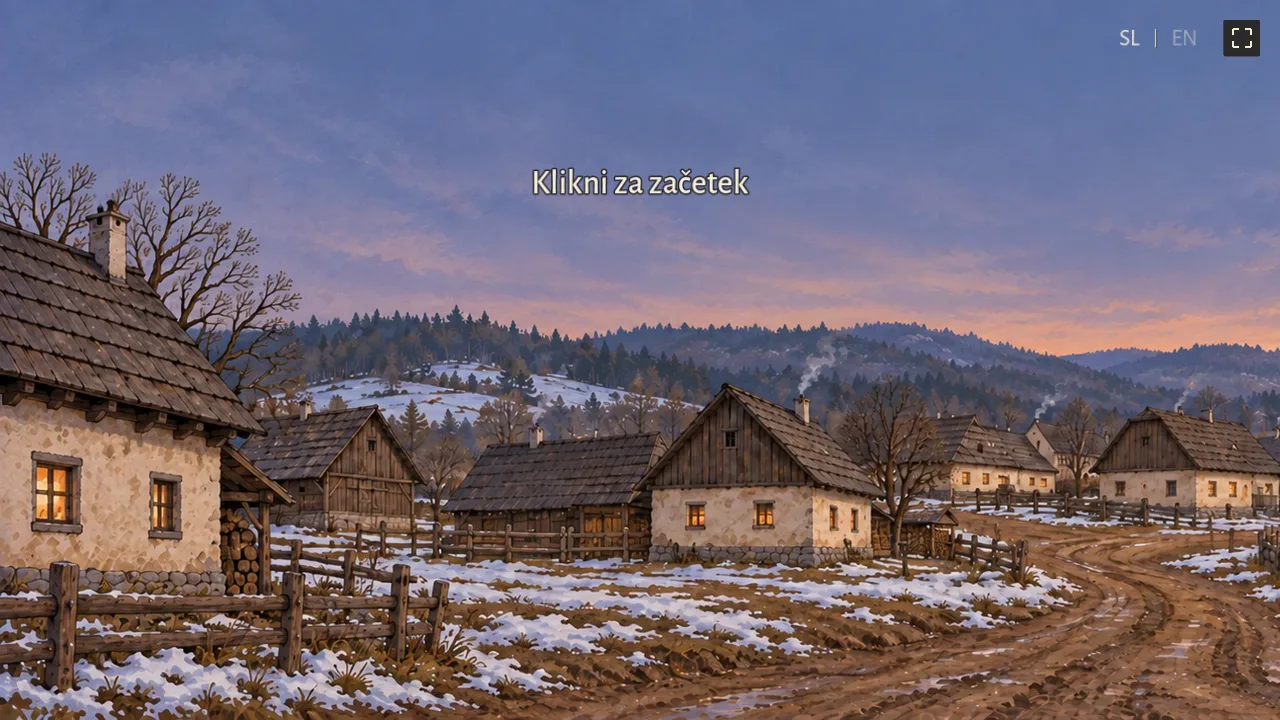
Tihotapska pot
A voiced point-and-click adventure about a salt smuggler and his mare in 1844 Slovenia; Act I is free to play in the browser, in Slovenian or English.
Links go to the official store or developer page. Last verified Nov 4, 2026.
Where to play
Every platform this game is on. Links are checked against official sources; we never host or mirror games.
- View demo on BrowserBrowserDemo · Act I only (about 20 minutes); the game is in development. The test build logs play and sends it to the developer, as its first screen saysFree
Runs in a desktop browser. No download.
Browser (no download) · Official link verified Nov 3, 2026.
About Tihotapska pot
A painted, fully voiced point-and-click adventure in the browser, in Slovenian or English. The hero is Martin, a salt smuggler from the Bloke plateau in 1844, with a mare, a lot of strength and plenty to say. Act I, the only part playable so far and about 20 minutes long, is one village: his leaking pot, a neighbour's pot he has to return, an inn with two carters who do not want to pay, a vagrant eating the innkeeper's bacon in her cellar, a torn pack strap, a smith with an anvil to move, a bundle of hay, and the mare to lead out of the stable before the road to Trieste. You choose Martin's lines in conversations, the mare answers in horse, and clicking Martin gives a hint. The developer says the story is based on an 1858 story, and that a Claude session studied a walkthrough of Monkey Island's Special Edition to measure how its conversations work; nothing of that game's art, lines or music went into this one. It is the developer's first game, made with AI agents: Claude Code with Opus 5.5 did the code, content and planning, Claude Fable 5.1 wrote the dialogue, Codex painted the images, and the voices are Gemini text-to-speech recordings. The developer writes that the agents wrote 5,000 lines of code. Free; the test build logs your clicks and sends them to the developer, says so on its first screen and can be switched off.
How it was built
Partially verifiedThe developer's devlog of 14 Oct 2026 credits “Code, content, plan, orchestration” to Claude Code with Opus 5.5, and every player-facing line, in Slovenian and English, to Claude Fable 5.1 working as a subagent; the developer's own part was design, taste, scope and playtesting, in 551 messages. The developer writes that the agents wrote 5,000 lines of code; at the end of Act I the game had 5,299 lines of GDScript, 1,820 lines of Python tools and 155 tests. The earlier devlog of 25 Sep 2026 says Claude Code wrote the design documents and all game code from the second day on, and drove Codex in the background on the first day.
- DeveloperFirst devlog's credits: Claude Code (Opus 5.5, Fable 5.1 from day four) did the design documents, all game code from day two, orchestration and the development plan. — hello nunc (nunc)
Per the first devlog, Codex (GPT-6 Astra) wrote the code of the first milestone on day one, from prompts written by Claude Code; from day two it only painted (backgrounds, sprites and animation frames, with its built-in image generator) and gave independent reviews of the code and art. The Act I devlog lists it for paintings, sprites, animation frames and reviews, with GPT-6.1-Sol from 14 October.
- DeveloperAct I credits: “Paintings, sprites, animation frames, independent reviews | Codex, GPT-6 Astra, from 14 October GPT-6.1-Sol”. — hello nunc (nunc)
The developer gave the agents a 1,472-line game bible and keeps a decisions file of 86 dated owner decisions in the developer's own words; the agents propose and log each complaint as a numbered decision. A build gate (a content validator, a voice check, 155 tests including whole-act play-throughs and the web export) runs before every commit, a Claude agent plays the act blind through a browser bridge, and Codex plays both routes in Playwright. The voices were generated during development with Gemini 3.8 Flash TTS (573 Slovenian and 573 English recordings, checked by transcription with Gemini 3 Flash), the music with Lyria, and Grok 4.7 was tried as a second image model; sound effects are from CC0 libraries. Nothing is generated while you play. The English voices are a separate download fetched only when English is chosen.
- Engine / framework
- Godot 4.7.2
- Languages
- GDScript, Python
- Team size
- Not disclosed
- Initial build time
- Four days to a first voiced demo; 23 days until Act I was declared finishedDeveloper Reportedhello nunc (nunc)
- Development time
- Not disclosed
- Development cost
- Not disclosed
- AI-written code
- Not disclosed
“The agents wrote 5,000 lines of code and 1,146 voice files, and they complained too”- I Finished Act I of My First Game (devlog, 14 Oct 2026)
- Two AI Agents Built a Slovenian Point-and-Click Adventure in Four Days (devlog, 25 Sep 2026)
Verification notes: AI use, roles, models, line counts, tests, voices, decisions and tester numbers from the developer's two devlogs on hellonunc.com (25 Sep and 14 Oct 2026, author nunc; the second is also on dev.to, published 14 Oct 2026 15:06 UTC). The test page is a Godot web export; the site root shows the title and “V razvoju · In development”. Act I contents, the 20-minute length, the 1844 setting and the hero come from the Act I devlog; we did not play through the act. The devlogs say the story follows an 1858 story and Slovenian folk and literary stories without naming the work; the first devlog's address uses the word “krpan”. Monkey Island is named by the developer as a reference that a separate Claude session studied for the project (conversation structure and hint pacing); per the devlog no art, lines or music from it were used, so no IP notice is shown. About 38 testers in 67 logged sessions played Act I by 14 Oct, per the developer (not recorded as a metric). The test build sends a click log to the developer's server after a notice and an optional nickname, and the setting to turn it off is in the options, per the devlog. Voices, music and images were generated during development; no source mentions generative AI running during play. The developer's real name, location and team size are not stated; the site invites volunteers to lend voices, proofread or test.
Development history
Work starts: the agents write seven design documents from the developer's game bible, and Codex, driven by Claude Code, codes the first milestone overnight.
Developerhello nunc (nunc)The developer removes the password from the test page and posts the link in a Slovenian developer Discord.
Developerhello nunc (nunc)Act I declared finished (decision 86 in the project log); the devlog is published on hellonunc.com and dev.to.
Game performance
Each figure measures something different — concurrent players, owners, downloads and sales are never interchangeable and are never added together. Labels show where each number comes from.
Browser (official site)
No public metrics recorded for this listing.
Not publicly available: Concurrent players (site), Monthly revenue, Gross revenue.
Sales & revenue (all platforms)
Browser game — there are no downloads to count.
Reviews & rankings
Not yet reviewed by our editors.
Not currently ranked.
Sources
| Source | Type | Published | Accessed |
|---|---|---|---|
| I Finished Act I of My First Game. 23 Days, 86 Decisions, 38 Testers and a Mare That Answers in Horse. hello nunc (nunc) | Devlog | Oct 14, 2026 | Nov 3, 2026 |
| Two AI Agents Built a Slovenian Point-and-Click Adventure in Four Days. The 300-Pixel Hero Was the Hard Part. hello nunc (nunc) | Devlog | Sep 25, 2026 | Nov 3, 2026 |
| I Finished Act I of My First Game (cross-post) DEV Community (nunc) | Devlog | Oct 14, 2026 | Nov 3, 2026 |
| Tihotapska pot / The Smuggler's Road smugglersroad.com | Official site | Not confirmed | Nov 3, 2026 |
Similar games