小さな帝国
A very small turn-based 4X in the browser: two workers, a 5×5 board and 15 technologies, racing a CPU city for food, production and gold. The developer made the design decisions and left the implementation to Claude Code.
Official site satou20250828.github.io, verified Nov 3, 2026. Linked as the service URL (サービスURL) in the README of the developer's Satou20250828/micro-empire repository and at the top of every part of the developer's Qiita series.
Where to play
Every platform this game is on. Links are checked against official sources; we never host or mirror games.
- Play free — official siteBrowserReleasedFree
Runs in a desktop or mobile browser. No download.
Browser (no download) · Mobile · Official link verified Nov 3, 2026.
- View on GitHubGitHubReleased · Source code (Vite and vanilla JavaScript); no licence file foundFree
Source code repository, not a place to play.
Official link verified Nov 3, 2026.
About 小さな帝国
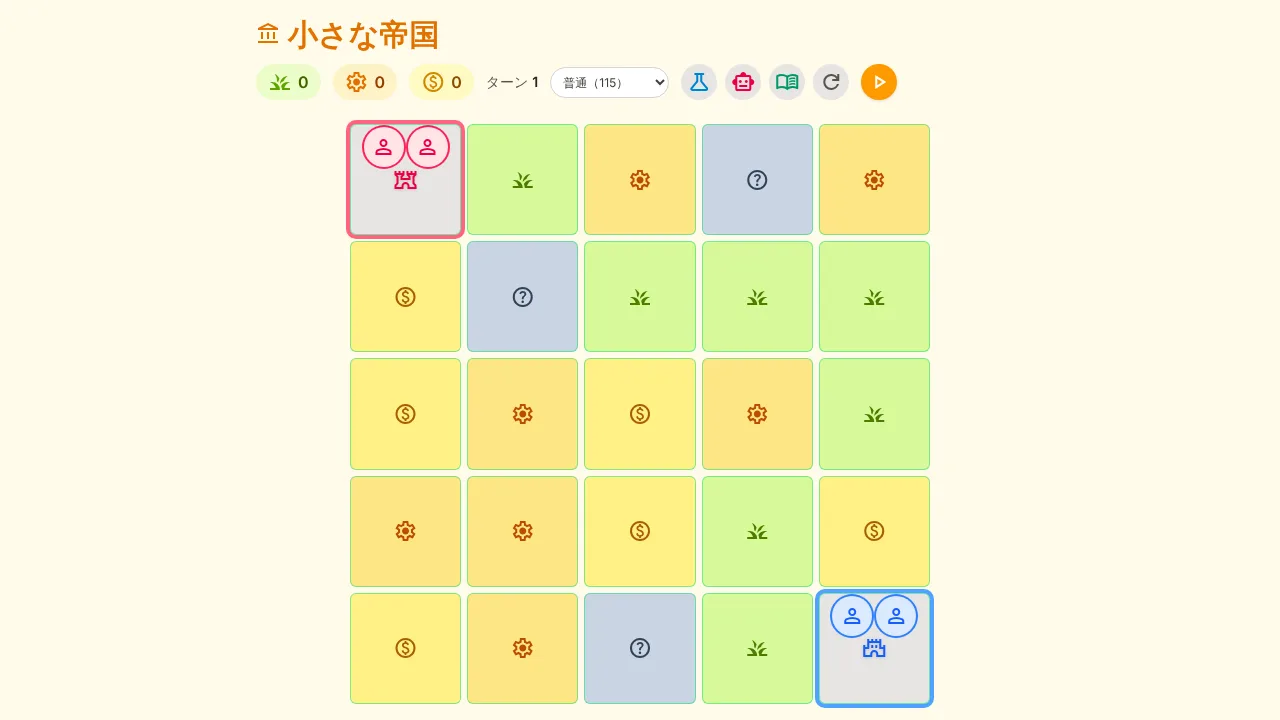
小さな帝国 (Chiisana Teikoku, “a small empire”) is a free turn-based economy game that runs in the browser, in Japanese. Your city and a CPU city sit in opposite corners of a 5×5 board; the other squares are food, production or gold terrain, and three are hidden “?” squares whose result (a bonus, nothing, or a loss) is drawn again every time a worker arrives. Each side has two workers that move one square to a neighbouring square per turn and collect whatever their square produces; a worker that stays on the same square for three turns in a row is forced to move on the fourth. There is no combat: the CPU follows the same movement rules and competes for the same resources. Resources buy technologies in three lines of five (agriculture, architecture and currency, 15 in all): tiers 1 to 3 raise output, tier 4 lifts one of the rule limits and tier 5 is a strong finisher for that line. You win by unlocking every technology or by reaching a resource total that depends on the difficulty (80 on Easy, 115 on Normal, 150 on Hard). Panels show the rules and the CPU's resources and technologies at any time. The README calls it a “super-mini 4X” in the style of Civilization, a series the developer says they have long been fond of, and says it was made to measure the developer's progress against their first program a year earlier, a text-based gomoku in Python. It was developed with Claude Code: the developer says they made every decision on what to build, why and which design to use, and left the implementation (code generation, refactoring, tests and Issue and PR text) to Claude Code. Free on GitHub Pages, with the source on GitHub.
How it was built
Partially verifiedThe README section on working with AI (AIとの協働について) says the project was developed with Claude Code, Anthropic's AI coding agent. The developer kept every decision (what to build and why, the design, and whether to adopt the AI's suggestions) and left the implementation work to Claude Code: code generation, refactoring, writing test code and drafting Issue and PR text. To avoid handing over the decisions, the AI first laid out options with their pros and cons, the two then worked out the criteria, and the developer picked an option; each Issue records these exchanges. The first part of the Qiita series adds that the developer wanted to avoid the misunderstanding that AI made everything. No model is named and no share of AI-written code is given.
- DeveloperFinal part of the Qiita series (19 Sep 2026): implementation was left to the AI (Claude Code) while the developer decided what to build, why and which design to adopt. — Qiita (satou_learning)
A Vite and vanilla JavaScript app styled with Tailwind CSS v4 and tested with Vitest, deployed to GitHub Pages by GitHub Actions; the board is drawn with HTML elements rather than a canvas, and all state lives in one place and is redrawn by a single render() function. The developer ran it with Git Flow branches and Issue-driven development, with lint and tests on every pull request. The final part of the Qiita series reports 65 commits, 21 Issues, 28 pull requests, releases v1.0.0 to v1.0.4 and 78 unit tests in 9 files for the logic layer. The core rules were rebuilt twice during requirements, from territory expansion to occupation by pieces to worker placement. The CPU opponent is rule-based and reuses the player's movement logic.
- Engine / framework
- None (vanilla JavaScript with Vite and Tailwind CSS)
- Languages
- JavaScript
- Team size
- 1 (solo)Developer ReportedQiita (satou_learning)
- Development time
- Not disclosed
- Development cost
- Not disclosed
- AI-written code
- Not disclosed
“実装作業はAIに任せる:コード生成・リファクタリング・テストコード作成・Issue/PR文面の作成などは、Claude Codeに任せています”Verification notes: AI use comes from the README of the Satou20250828/micro-empire repository (read from raw.githubusercontent.com on 4 Nov 2026) and the developer's Qiita series: part 1 (4 Sep 2026, Japan time) and part 8 (19 Sep 2026). The Qiita profile links the GitHub account Satou20250828. The github.com page and the GitHub API were not reachable from our session, so stars, commit dates and release dates were not read; no LICENSE file was found and package.json is marked private (version 1.0.4), so the game is not tagged open source. Team size: the series is tagged 個人開発 (personal development) and written in the first person; no other person is named. Part 8's title speaks of four releases while its body lists five (v1.0.0 to v1.0.4). The release date is not stated; part 1, published 4 Sep 2026, already links the live game. Civilization is named as the developer's inspiration only; no names or assets from it were found. Rules, tiers and win thresholds come from the README. The CPU opponent is described as a simple rule-based AI (CPU簡易AI); the game's script makes no network requests apart from loading its own files, so no AI service runs during play. Japanese interface (page lang=ja); no language setting found. The game was not played through.
Development history
The developer starts an eight-part Qiita series on the game, linking the live version on GitHub Pages and stating that it is developed with Claude Code.
DeveloperQiita (satou_learning)The final part of the series reports 65 commits, 21 Issues, 28 pull requests and releases v1.0.0 to v1.0.4.
DeveloperQiita (satou_learning)
Game performance
Each figure measures something different — concurrent players, owners, downloads and sales are never interchangeable and are never added together. Labels show where each number comes from.
Browser (official site)
No public metrics recorded for this listing.
Not publicly available: Concurrent players (site), Monthly revenue, Gross revenue.
GitHub
No public metrics recorded for this listing.
Not publicly available: GitHub stars.
Sales & revenue (all platforms)
Browser game — there are no downloads to count.
Reviews & rankings
Not yet reviewed by our editors.
Not currently ranked.
Sources
| Source | Type | Published | Accessed |
|---|---|---|---|
| micro-empire — README (小さな帝国) GitHub (Satou20250828) · Japanese | Repository | Not confirmed | Nov 3, 2026 |
| 5×5マスの陣取りゲームを作った話【小さな帝国 開発連載#1】 Qiita (satou_learning) · Japanese | Devlog | Sep 4, 2026 | Nov 3, 2026 |
| 65コミット・4回のリリースを経て見えたもの【小さな帝国 開発連載#8】 Qiita (satou_learning) · Japanese | Devlog | Sep 19, 2026 | Nov 3, 2026 |
| 小さな帝国 (game page and script) satou_learning · Japanese | Official site | Not confirmed | Nov 3, 2026 |
| Official game page (language check) satou_learning | Official site | Not confirmed | Nov 3, 2026 |
- Number of releases
- The title of part 8 of the Qiita series speaks of four releases (4回のリリース), while its body lists five (v1.0.0 to v1.0.4). (Qiita (satou_learning))
Similar games