ハコビ・アルゴリズム
Free · play online in your browser, no download
Lay conveyor belts, sorter gates, robot arms and humanoid robots to get parcels to the right drone ports in a 3D logistics-centre builder. The README says Claude Code built it.
Official site tanuu5.github.io, verified Nov 3, 2026. Linked as the play address (“▶ Play in your browser”) from the developer's own GitHub repository README (tanuu5/hakobi-algorithm); hosted on the developer's GitHub Pages.
Where to play
Every platform this game is on. Links are checked against official sources; we never host or mirror games.
- Play free — official siteBrowserReleasedFree
Runs in a desktop browser. No download.
Browser (no download) · Official link verified Nov 3, 2026.
About ハコビ・アルゴリズム
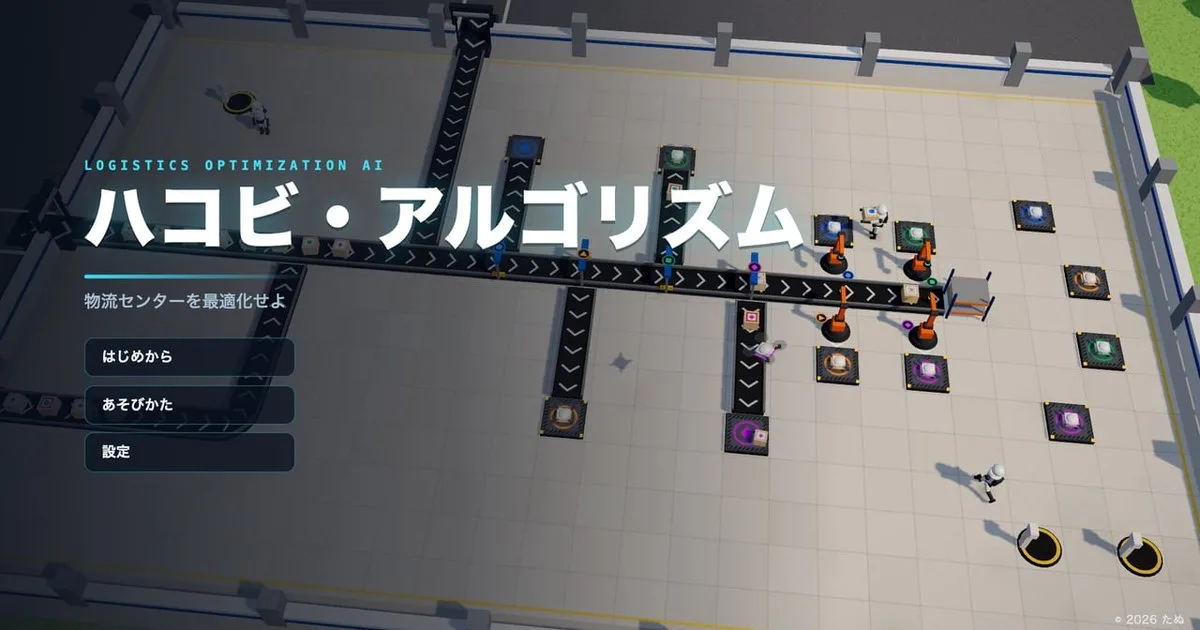
ハコビ・アルゴリズム (Hakobi Algorithm) is a free 3D factory-building game for the browser. You are HAKOBI, the AI brought in to optimise Logistics Centre No. 7: trucks unload parcels, each addressed to A, B, C or D, and you have to get them to drone ports for the same destination, since shipping from the wrong port is a misdelivery with a fine. On a grid you draw conveyor belts, split them with sorter gates that filter by destination, express, unreadable label or alternation, cross them, and place fixed robot arms that take from the tile behind and put on the tile in front (set between a belt and a port, an arm turns and sets its filter automatically). Shelves store parcels, humanoid robots find work on their own, carrying parcels from docks, shelves, dead ends and the floor, reading unlabelled ones and going off to recharge, and label machines make unreadable parcels readable. Each day lasts three minutes (with 2× and 4× speed) and starts paused for planning; anything you place can be removed for a full refund. An eight-day campaign adds express parcels with a 50-second deadline, unreadable labels, a sale-day rush and a storm that grounds the drones, followed by an overtime contract in which volume grows every day; an analysis view colours jams and full ports, and the AI's log points to the bottleneck. It plays with mouse and keyboard, a gamepad or touch, in Japanese or English. The README credits planning and direction to the developer, たぬ (tanuu5), and development to Claude Code (Claude Opus 5.5, reasoning level MAX). The factory, parcels, robots, drones, music and sound effects are all generated in code, with no image or audio files. Free on the developer's GitHub Pages site; the code is MIT-licensed.
How it was built
VerifiedThe README credits planning and direction to たぬ and development to Claude Code (Claude Opus 5.5, reasoning level MAX), and says Claude carried the game from design through implementation and testing, based on たぬ's plan. The factory simulation (parcels moving on belts, arms, drones, and job assignment and pathfinding for the humanoid robots) was built first, separately from the rendering, and run in Node alone to check that each day's quota can be reached and that nothing jams, gets stuck or overlaps. Claude also operated and captured the screens in headless Chrome to check the mouse, keyboard, gamepad and touch flows. たぬ played the game and had confusing parts and odd behaviour fixed several times before publishing. In a note post the developer says that apart from 狐火かぐら, the games in that batch took only a few exchanges, mostly bug reports.
- DeveloperDeveloper's note post of 24 Oct 2026: eight browser works, ハコビ・アルゴリズム among them, were made with Claude Code (Claude Opus 5.5) and published on GitHub between 9 and 23 Oct 2026. — note (たぬ / tank_ai)
Directed by one developer, with Claude Code (Claude Opus 5.5, MAX) doing design, code and testing. Built with three.js and published to GitHub Pages by GitHub Actions. Per the README, the factory simulation is kept separate from the rendering and was run headless in Node to test quotas, jams and overlaps; the screens were driven and captured in headless Chrome. The game uses no image or audio files and loads no external fonts.
- Engine / framework
- Three.js
- Languages
- JavaScript
- Team size
- Not disclosed
- Development time
- Not disclosed
- Development cost
- Not disclosed
- AI-written code
- Not disclosed
- Source on GitHub (tanuu5/hakobi-algorithm, MIT)
- Developer's note post on eight works made in two weeks (Japanese)
Verification notes: AI use, features, controls, languages, licence (MIT) and release date (2026-10-12, v1.0.0, from the README's update history) come from the developer's repository README, read through raw.githubusercontent.com on 5 Nov 2026; the README links the play address, which loaded that day. The remark about a few exchanges and bug reports comes from the note post of 24 Oct 2026, which also says the difficulty is fairly low at the time of writing and that the games in that batch support touch controls on smartphones. The player character is fiction driven by the game's own code; the bundled script contacts no AI services. The centre, company and people are fictional, per the README. The repository's stars and commit history were not checked (github.com was not reachable from our checker). Team size and location are not stated.
Development history
Game performance
Each figure measures something different — concurrent players, owners, downloads and sales are never interchangeable and are never added together. Labels show where each number comes from.
Browser (official site)
No public metrics recorded for this listing.
Not publicly available: Concurrent players (site), Monthly revenue, Gross revenue.
Sales & revenue (all platforms)
Browser game — there are no downloads to count.
Reviews & rankings
Not yet reviewed by our editors.
Not currently ranked.
Sources
| Source | Type | Published | Accessed |
|---|---|---|---|
| tanuu5/hakobi-algorithm (README) GitHub · Japanese | Repository | Not confirmed | Nov 3, 2026 |
| Claude Opus 5.5 が2週間で作った8つのブラウザ作品(PVつき) note (たぬ / tank_ai) · Japanese | Devlog | Oct 24, 2026 | Nov 3, 2026 |