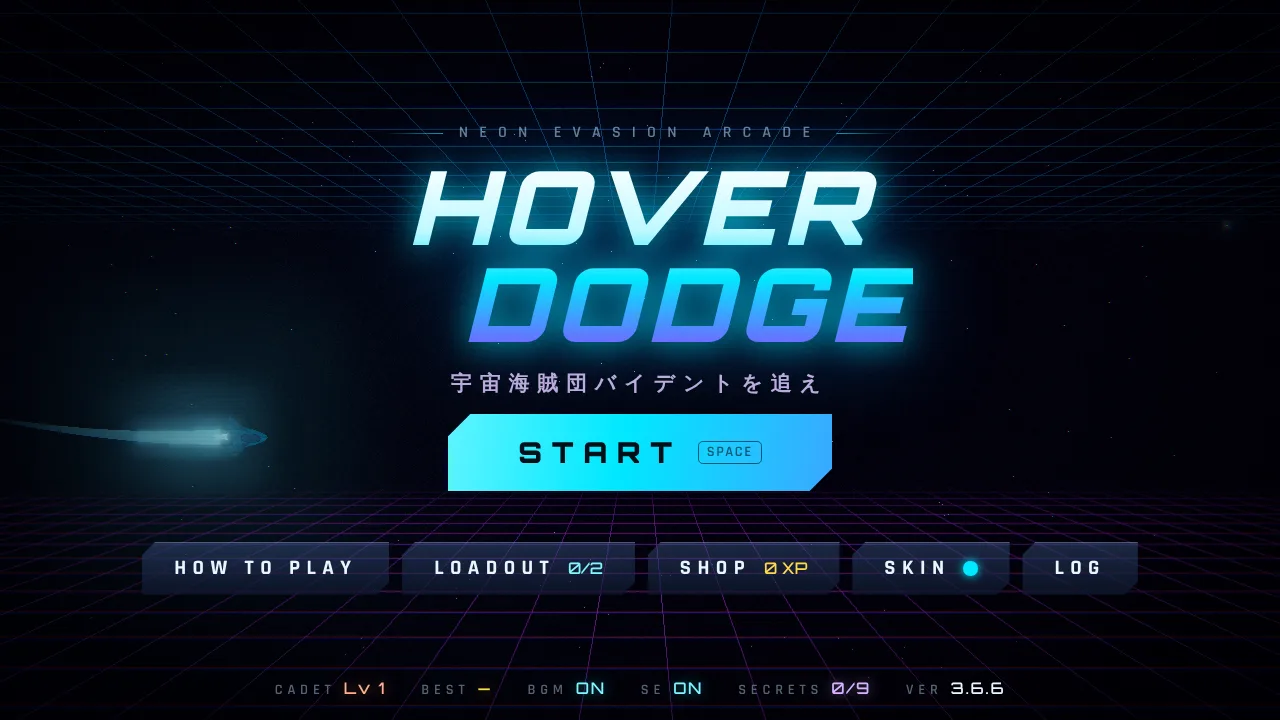
HOVER DODGE
Tap to flap and dodge walls and enemies as a little bird pilot, then take on 11 boss battleships across a four-chapter story. The developer says AI (Claude Code) wrote most of the code and most of the 3D models.
Official site junia2009.github.io, verified Nov 3, 2026. Linked from the developer's Qiita article (“HOVER DODGE を遊ぶ”) and from the README of the junia2009/hover-dodge repository.
Where to play
Every platform this game is on. Links are checked against official sources; we never host or mirror games.
- Play free — official siteBrowserReleased · Landscape only on phonesFree
Runs in a desktop or mobile browser. No download.
Browser (no download) · Mobile · Official link verified Nov 3, 2026.
- View on GitHubGitHubReleased · Source code (a single index.html); no licence file foundFree
Source code repository, not a place to play.
Official link verified Nov 3, 2026.
About HOVER DODGE
HOVER DODGE is a free side-scrolling arcade game in the browser, with Japanese story text, that the README describes as a Flappy Bird-style dodging game in a neon cyberpunk look. One tap (the space bar on a computer) makes your craft flap upwards; you dodge walls and enemies, and on phones you play in landscape. Survive long enough and a boss battleship arrives from the right: dodge its fire, collect cores and shoot it down with the main cannon, AEGIS CANNON. A PULSE button (Z on a keyboard) blows nearby enemies away and reflects bullets. You earn XP even when you crash, and spend it on a skill tree in the SHOP, equip skills in a LOADOUT and level up to pilot level 80. The story follows Rei, a small bird who dreams of being a space pilot, whose home planet is burned by space pirates; Rei takes off in an old craft found in the rubble, with Pallas, the AI that was sleeping inside it, a story character. Four chapters with 3D cutscenes bring 11 boss ships with names from Greek myth, among them the rivers Styx and Lethe, Charon, Hypnos and Nyx, and later chapters add their own twists: fog that makes you drowsy, a night in which you only see around your craft, and bubbles that make you forget a skill. Finishing the last chapter opens PILOT MODE, an endless flight through a galaxy at peace. Music and sound effects are synthesised in the browser, with no audio files, and the game can be installed to the home screen to play offline. The developer says they made it with Claude Code and that AI wrote most of the code and most of the 3D models, while the developer decided what to make, designed Rei, chose the story direction, read the pull-request diffs and played and critiqued every change. Free on GitHub Pages, with the source on GitHub.
How it was built
Partially verifiedThe developer's Qiita article says the game was made hand in hand with generative AI (Claude Code) and that AI wrote most of the code and almost all of the 3D models. Its table splits the work: the AI did the implementation (game logic, interface, shaders and music), made the other characters' and enemies' 3D models to match the developer's design of Rei, wrote setting documents and dialogue with several options to choose from, tested the game by driving a browser and taking screenshots, and handled version control, pull requests and merges; the developer decided what to make, designed Rei, chose the story direction, read each pull request's diff and played and critiqued. The 3D models other than Rei were written by the AI as code from Three.js primitives, previewed from several angles and exported to .glb once the developer approved. No model is named and no exact share is given.
The whole game is one index.html of about 11,000 lines, with no build step, using Three.js and WebGL and served from GitHub Pages; the developer notes the AI coped with the size by searching the file and editing only the parts it needed. Work ran as a loop: the developer said what to change, the AI branched, implemented, checked the game in a browser with screenshots and merged a pull request, and the developer read the diff and played it. The article reports development in May and October 2026, 221 commits and 98 pull requests (v1.0 to v3.6), 20 3D models and no audio files: music and effects are synthesised with Web Audio and change on the next bar when a phase or boss begins. A service worker provides offline play and update notices, and GoatCounter records anonymous events such as where players crash.
- Engine / framework
- Three.js
- Languages
- JavaScript
- Team size
- 1 (solo)Developer ReportedQiita (Uri_memo)
- Development time
- Not disclosed
- Development cost
- Not disclosed
- AI-written code
- Not disclosed
“コードの大半と、ほとんどの 3D モデルは AI が書きました。”Verification notes: AI use comes from the developer's Qiita article (posted 9 Oct 2026, Japan time; last updated 1 Nov 2026), which names Claude Code at the top and links the game and the repository. The tie between the Qiita account Uri_memo and the GitHub account junia2009 rests on those links. Team size: the Qiita profile says the developer makes games and apps as an individual (個人で). Chapters, bosses, skills (the README gives 42 in its summary and 36 in its skill-tree section) and modes come from the article and the repository's README (read from raw.githubusercontent.com on 4 Nov 2026; version 3.6.6, matching the game's script). The github.com page and API were not reachable from our session, so stars and dates were not read; no LICENSE file was found, so the game is not tagged open source. The release date is not stated; the article reports work in May and October 2026 and was posted on 9 Oct 2026. The README's “Flappy Bird-style” is the developer's own description of the genre; no names or assets from that game were found, and the boss names come from Greek myth. Pallas and Paulo, the in-game AI companions, are scripted story characters; the game's script makes no network requests apart from loading Three.js, fonts and the GoatCounter counter, so no AI service runs during play. The story text is in Japanese; a few prompts are also in English and no language setting was found. The game was not played through.
Development history
- May and October 2026
Development periods given by the developer: 221 commits and 98 pull requests from v1.0 to v3.6.
DeveloperQiita (Uri_memo) The developer introduces the finished four-chapter game on Qiita and explains how it was built with Claude Code.
DeveloperQiita (Uri_memo)
Game performance
Each figure measures something different — concurrent players, owners, downloads and sales are never interchangeable and are never added together. Labels show where each number comes from.
Browser (official site)
No public metrics recorded for this listing.
Not publicly available: Concurrent players (site), Monthly revenue, Gross revenue.
GitHub
No public metrics recorded for this listing.
Not publicly available: GitHub stars.
Sales & revenue (all platforms)
Browser game — there are no downloads to count.
Reviews & rankings
Not yet reviewed by our editors.
Not currently ranked.
Sources
| Source | Type | Published | Accessed |
|---|---|---|---|
| 生成AIを用いて全力で作りたいゲームを作ってみたらけっこう大作が出来上がった話 Qiita (Uri_memo) · Japanese | Devlog | Oct 9, 2026 | Nov 3, 2026 |
| junia2009/hover-dodge — README GitHub (junia2009) · Japanese | Repository | Not confirmed | Nov 3, 2026 |
| HOVER DODGE (game page and script) Uri_memo (junia2009) · Japanese | Official site | Not confirmed | Nov 3, 2026 |
| Official game page (language check) Uri_memo (junia2009) | Official site | Not confirmed | Nov 3, 2026 |
Similar games