KINDLE
Walk a tiny planet you can circle in about a minute as its last lamplighter, find the nine beacons that have gone out and bring the land back to life. The README says Claude Opus 5 built it in one unattended Claude Code session from three prompts.
Official site tonydowney.github.io, verified Nov 3, 2026. Linked as “Play it in your browser” at the top of the README of the developer's TonyDowney/kindle repository.
Where to play
Every platform this game is on. Links are checked against official sources; we never host or mirror games.
- Play free — official siteBrowserReleased · Needs WebGL2; touch controls on phonesFree
Runs in a desktop or mobile browser. No download.
Browser (no download) · Mobile · Official link verified Nov 3, 2026.
- View on GitHubGitHubReleased · Source code (MIT); kindle.html can also be downloaded and opened offlineFree
Download from the GitHub releases page.
Desktop · Official link verified Nov 3, 2026.
About KINDLE
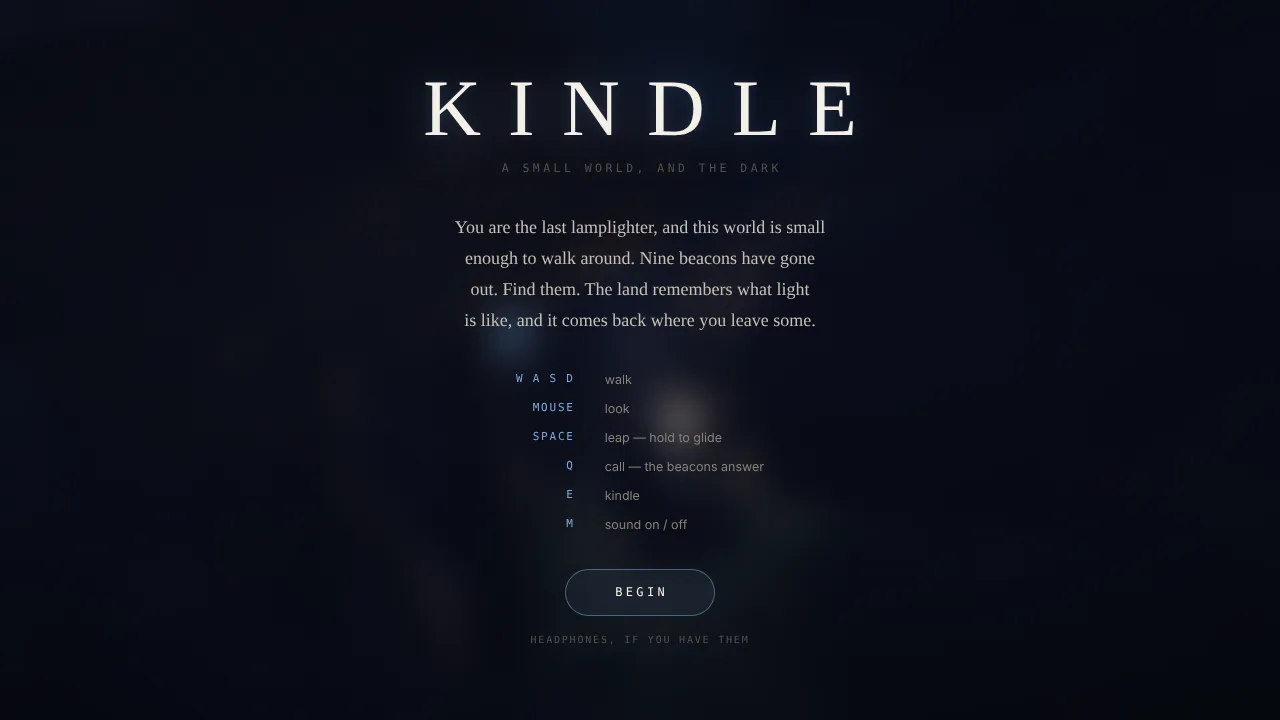
KINDLE is a free 3D exploration game in the browser. You are the last lamplighter of a planet small enough to walk all the way round in about a minute, and nine beacons have gone out. The world is dark; you walk, leap and glide over a spherical planet whose horizon curves away close by, so climbing a hill shows you more. Pressing Q sends the Call, a ring of light that travels across the surface and makes nearby beacons answer with a column of cold light, which is how you find your way. Each beacon stands at a different kind of place, such as a shore, a peak, a wood, a basin or a field of glass, and carries a fragment about the people who used to keep them; lighting one with E turns the grey heath around it back into meadow in a widening circle and the trees grow their leaves back. Lighting all nine ends in a sunrise. Each planet is generated from a seed (add ?seed= and a number to walk a given one again), and on a phone the left thumb walks and the right thumb looks. The whole game is one 267 KB HTML file written directly against WebGL2, with no libraries, and all terrain, props and sound are generated when the page loads. The README says Claude Opus 5 built it in a single unattended Claude Code session from three prompts, which it reproduces in full along with how they were interpreted. Free on GitHub Pages, with the source on GitHub under the MIT licence.
How it was built
Partially verifiedThe README says the game was built by Claude Opus 5 in a single Claude Code session, unattended, from three prompts, and reproduces all three. The first asked for a small “gamejam”-style game on the theme “explore”, in 3D, with a one-million-token budget, and told the model not to ask for clarification; the second asked what more it wanted to do; the third asked it to publish the game in a public repository on the requester's GitHub account and write a README covering every human prompt. The README, written in the model's voice, explains each decision: matching the raw WebGL2 approach of two Anthropic demo pages linked in the prompt, making the world a small sphere, and choosing the lamplighter, the nine beacons, the palette and the text itself. About a third of the effort went into a test harness, including a dependency-free Chrome DevTools client it wrote instead of using the Chrome MCP; a multi-seed test found that the terrain was nearly flat and two beacon types could never be placed, which was fixed. The model also chose GitHub Pages for hosting and added the MIT licence.
Written directly against WebGL2 in JavaScript and GLSL, with no Three.js, engine or libraries; a small build script (tools/build.js) inlines the src/ tree into one self-contained index.html, byte-identical to the downloadable kindle.html, and refuses to emit a file that does not parse or references anything outside itself. The README gives the scale: terrain of 327,680 triangles from an icosahedron subdivided seven times and displaced by 3D simplex noise, about 26,000 instanced procedural trees, rocks and crystals, audio from oscillators, noise and FM bells with no samples, a 267 KB file and about 1.5 s to generate a planet. The world is deterministic from a seed. Tests drive an isolated headless Chrome through the DevTools protocol: ten seeds checked for nine reachable beacons, height histograms, climbability, audio levels on the master bus, findability geometry, frame times and a check of the deployed site showing it fetches nothing but the page. Hosted on GitHub Pages.
- Engine / framework
- None (raw WebGL2, vanilla JavaScript)
- Languages
- JavaScript, GLSL
- Team size
- Not disclosed
- Development time
- Not disclosed
- Development cost
- Not disclosed
- AI-written code
- Not disclosed
“This game was built by Claude Opus 5 in a single Claude Code session, unattended, from three prompts.”Verification notes: AI use, the three prompts, features and test figures from the repository README, read as a raw file on 4 Nov 2026. The README is written in the model's voice and quotes the human prompts; it says the session ran unattended but gives no percentage, so no AI code share is recorded. The “gamejam” in the first prompt is the requester's framing; no real game jam is named, so the game is not tagged as a jam game. The developer's name comes from the licence file (© 2026 Tony Downey), which the README says Claude added with the requester as the copyright holder. The game page (title “KINDLE — a small world, and the dark”, page language en, 273 KB) loaded on 4 Nov 2026; it contains no network requests, so no AI service runs during play. The github.com page and API were not reachable from our session, so the publication date and commit history were not read; the release date is left blank. The game was not played through.
Game performance
Each figure measures something different — concurrent players, owners, downloads and sales are never interchangeable and are never added together. Labels show where each number comes from.
Browser (official site)
No public metrics recorded for this listing.
Not publicly available: Concurrent players (site), Monthly revenue, Gross revenue.
GitHub
No public metrics recorded for this listing.
Not publicly available: GitHub stars.
Sales & revenue (all platforms)
Browser game — there are no downloads to count.
Reviews & rankings
Not yet reviewed by our editors.
Not currently ranked.
Sources
| Source | Type | Published | Accessed |
|---|---|---|---|
| KINDLE — README GitHub (TonyDowney) · English | Repository | Not confirmed | Nov 3, 2026 |
| KINDLE — a small world, and the dark (game page) Tony Downey (GitHub Pages) · English | Official site | Not confirmed | Nov 3, 2026 |
| Official game page (language check) Tony Downey | Official site | Not confirmed | Nov 3, 2026 |
Similar games