Forja Abisal
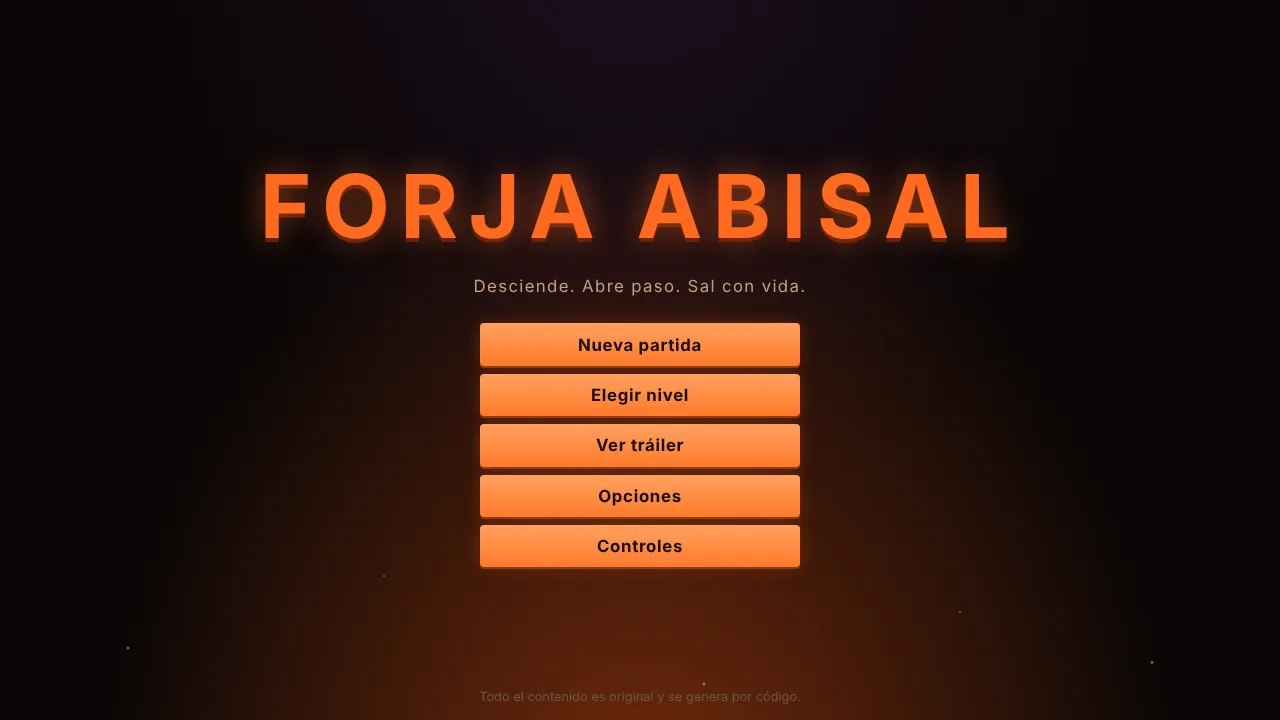
A free retro first-person shooter for the browser, a homage to the shooters of the 1990s: three key-and-door levels in an infested forge, five weapons and code-generated everything. The README says it was developed with Claude Code from the author's specifications.
Official site carte1972.github.io, verified Nov 3, 2026. Linked as the browser version (“Demo”) at the top of the README in the developer's repository Carte1972/forja-abisal.
Where to play
Every platform this game is on. Links are checked against official sources; we never host or mirror games.
- Play free — official siteBrowserReleased · Called a demo (“Demo”) in the README; it holds the full three-level campaign of version 1.0.0Free
Runs in a desktop browser. No download.
Browser (no download) · Official link verified Nov 3, 2026.
- View on GitHubGitHubReleased · Source code (TypeScript, Three.js, Rapier; MIT licence), with double-click launchers for macOS, Windows and Linux that build and serve the game locallyFree
Download from the GitHub releases page.
Desktop · Official link verified Nov 3, 2026.
About Forja Abisal
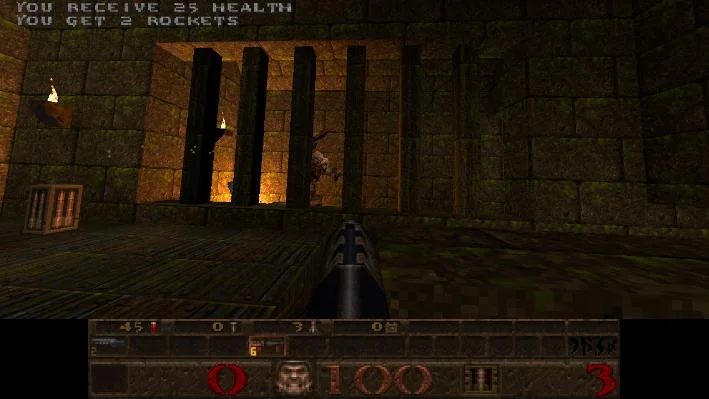
Forja Abisal (Spanish for roughly “Abyssal Forge”) is a free retro 3D first-person shooter for the browser that its README presents as a homage to the first-person shooters of the 1990s. You descend through an abandoned, infested forge level by level. In each of the three levels, Fundición Cero, Pozos de Ceniza and Núcleo Abisal, with 13, 21 and 34 enemies, you find the red, blue and yellow keys that open the coloured doors and reach the exit switch, and each level hides at least two secrets. Five weapons, from a piston hammer to a charge launcher whose blasts allow rocket jumps, each have a primary and an alternate fire. Four enemy types see you inside a cone of vision, hear gunfire along corridors, chase you over a navigation mesh and turn on each other when one hurts another. There are lifts, secret walls, lava and acid floors, an automap that fills in as you explore, and an end-of-level score for time, kills, items and secrets. The README says all content, from models, textures and sounds to levels and names, is original and generated by code, with no assets from other games. It is in Spanish, played with mouse and keyboard, and also runs offline from the repository through launchers for macOS, Windows and Linux. According to the README, the game was developed with Claude Code, using Claude Opus 5.5, from two specifications written by the author, who made the design decisions and tested the result after each phase. The source is MIT-licensed.
How it was built
Partially verifiedThe README says the game and its trailer were developed with Claude Code (CLI version 2.1.283) from two specifications written by the author, who made the design decisions and reviewed and tested the result at the end of each phase. For the game up to version 1.0.0 it lists Claude Opus 5.5 (claude-opus-5-5) as the main model, with 644 calls at high reasoning effort, about 3 h 35 min of active work, about 297 million tokens processed and about 937,000 generated, ending in 10 phases, screenshots, a player guide and 254 tests; Claude Sonnet 5 analysed the levels for the player guide in 6 calls. The trailer took another 203 Opus 5.5 calls and about 1 h 57 min. The README says the figures are as of 26 September 2026 and that the active time is an estimate that leaves out the pauses for testing between phases.
Spec-driven development with Claude Code: the author wrote a project specification and a trailer specification, and the game was built in 10 phases up to version 1.0.0, with the author testing after each phase. Per the README, the game uses Three.js, Rapier physics, recast-navigation-js for enemy pathfinding, postprocessing, React and Vite; textures and sounds are synthesised in code at start-up, levels are written as sector data from which the geometry is generated, and Vitest tests cover movement, weapons, AI, doors, lifts, sound synthesis, the geometry generator and whether each level's keys, exit and secrets can be reached. The roughly two-and-a-half-minute trailer is also generated in the repository: the game records its own clips, a macOS voice reads the script as a placeholder, the music is synthesised and Remotion assembles the video.
- Engine / framework
- Three.js
- Languages
- TypeScript
- Team size
- 1 (solo)Developer ReportedGitHub (Carte1972)
- Initial build time
- About 3 h 35 min of active agent work to version 1.0.0, not counting the pauses for testing between phasesDeveloper ReportedGitHub (Carte1972)
- Development time
- Not disclosed
- Development cost
- Not disclosed
- AI-written code
- Not disclosed
“El juego y su vídeo de presentación se desarrollaron con Claude Code (CLI, versión 2.1.283), a partir de dos especificaciones escritas por el autor.”Verification notes: AI use, models, call counts, tokens and active time come from the README section “Recursos empleados” (Spanish), which says the figures are as of 26 Sep 2026; gameplay, weapons, enemies, levels, controls, the offline launchers and credits from the same README, and the MIT licence from the LICENSE file (© 2026 Carte1972). The README and the game page were read through raw.githubusercontent.com and GitHub Pages (the browser build loaded on 4 Nov 2026); github.com and the GitHub API did not answer our checks, so the repository's creation date, commit history and stars are unchecked and no release date is known. Team size 1 rests on the README's references to a single author (“el autor”) who wrote the specifications and made the design decisions; no real name or location is given. The README calls the game a homage to 1990s first-person shooters in general and says it uses no assets, names or levels from other games. The trailer narration uses a macOS system voice, which the README calls provisional. Nothing in the sources describes AI used during play. The game was not played.
Development history
- By 26 September 2026
Version 1.0.0 of the game and its trailer finished with Claude Code; the README's usage figures are dated 26 Sep 2026.
DeveloperGitHub (Carte1972)
Game performance
Each figure measures something different — concurrent players, owners, downloads and sales are never interchangeable and are never added together. Labels show where each number comes from.
Browser (official site)
Free in the browser with no install; needs a modern browser with WebGL 2, mouse and keyboard.
No public metrics recorded for this listing.
Not publicly available: Concurrent players (site), Monthly revenue, Gross revenue.
GitHub
No public metrics recorded for this listing.
Not publicly available: GitHub stars.
Sales & revenue (all platforms)
Browser game — there are no downloads to count.
Reviews & rankings
Not yet reviewed by our editors.
Not currently ranked.
Sources
| Source | Type | Published | Accessed |
|---|---|---|---|
| Forja Abisal — README (sections “Recursos empleados” and “Créditos y licencia”) GitHub (Carte1972) · es | Repository | Not confirmed | Nov 3, 2026 |
| Forja Abisal (browser build) Carte1972 (GitHub Pages) · es | Official site | Not confirmed | Nov 3, 2026 |
| Official game page (language check) Carte1972 | Official site | Not confirmed | Nov 3, 2026 |
Similar games